
The Treatment Exists. Why Does It Reach So Few?
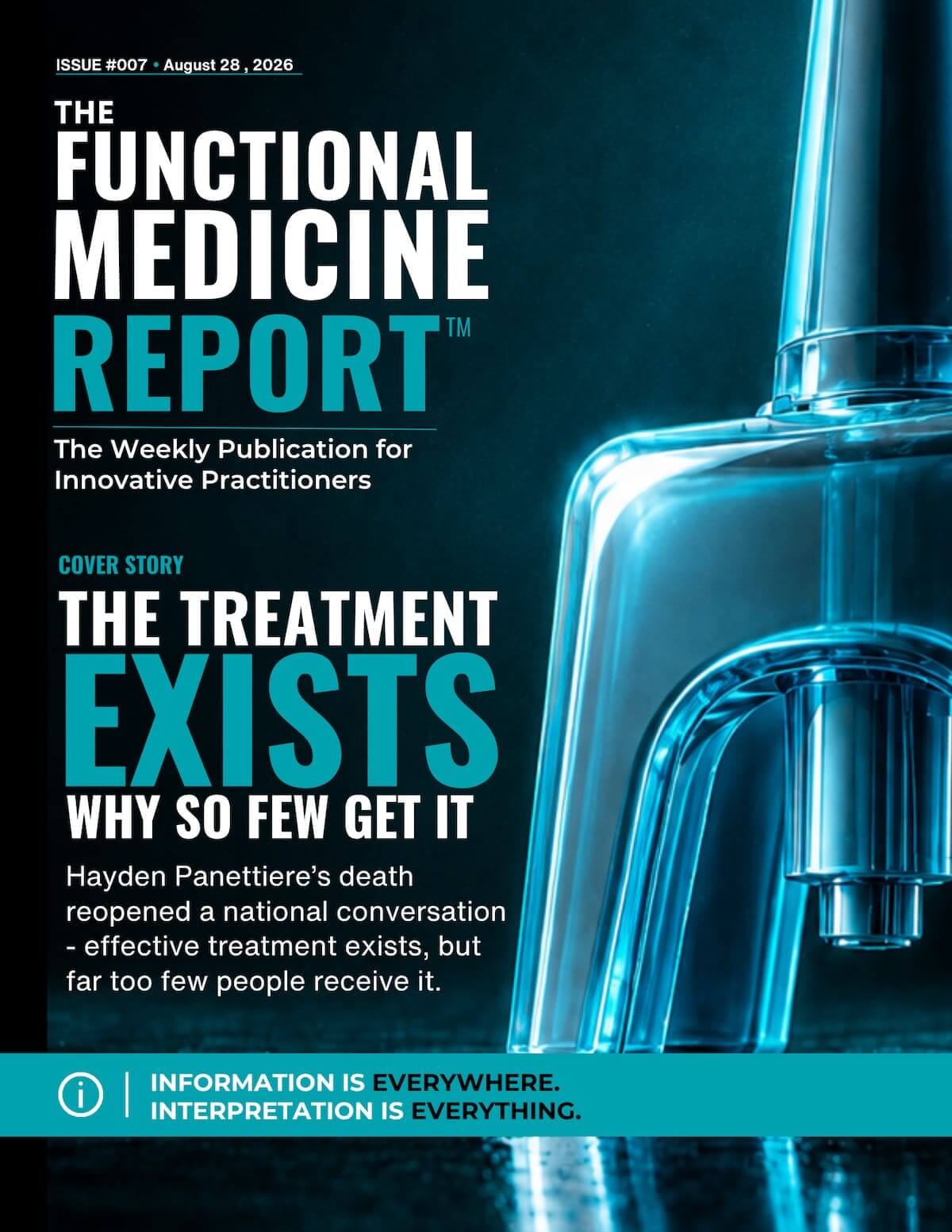
By The Functional Medicine Report™
Originally published August 28, 2026 in Issue #007 of The Functional Medicine Report™
Hayden Panettiere’s unresolved death has reopened a familiar conversation about addiction, recovery and personal failure. The verified national story is harder: effective treatment exists, federal barriers have been reduced and overdose deaths are declining—yet fewer than one in six people with opioid use disorder receive medication.
Key Takeaways
- The gap is delivery, not discovery. Approximately 4 million people aged 12 or older had opioid use disorder in the previous year, and about 623,000 reported receiving medication for it — fewer than one in six, or 15.7%. The estimate comes from the 2025 National Survey on Drug Use and Health, which is self-reported and covers the civilian, noninstitutionalized population.
- Staying in treatment is part of the treatment. A systematic review in The BMJ examined 19 observational cohort studies involving more than 138,000 people and found substantially lower mortality during methadone treatment than during periods outside it. Risk rose again after methadone or buprenorphine treatment stopped, particularly in the early weeks.
- Detoxification is not treatment, and naloxone is not treatment. Withdrawal management can move someone through acute withdrawal without providing continuing management of the disorder. Naloxone can reverse opioid poisoning and preserve the possibility of treatment, but it does not treat opioid use disorder.
- Mortality is improving and the gap persists at the same time. The United States recorded 79,384 overdose deaths in 2024 — a 26.2% decline in the age-adjusted rate and the largest annual percentage decrease in the 2014–2024 period. Provisional estimates put 2025 near 69,973. Most people with opioid use disorder still receive no medication.
- Removing a barrier is not the same as building a pathway. The X-waiver was eliminated in 2022, over-the-counter naloxone nasal spray was approved in 2023 and federal opioid-treatment-program rules were modernized in 2024. None of those changes created clinician confidence, pharmacy supply, transportation, treatment capacity or follow-up.
- Functional medicine’s root-cause instinct should surround evidence-based OUD treatment, not compete with it. No patient should have to resolve every trauma, complete a nutritional program or wait behind a microbiome theory before receiving care for a condition carrying substantial mortality risk.
The Number That Changes the Story
Hayden Panettiere was 36 when she died. Within hours, the public already seemed to know the story—or thought it did. She had spoken openly about addiction, depression, treatment and recovery, and first responders had reportedly been dispatched to a possible overdose. The conclusion practically wrote itself.
Except the conclusion is not known.
Her autopsy found no trauma that contributed to her death. Authorities reported no evidence of foul play. Toxicology remains pending, and her official cause and manner of death have not been determined. No verified finding has established that opioids, alcohol, prescription medication, multiple substances or any other specific mechanism caused her death.
That uncertainty is not a detail to rush past. A known addiction history may be relevant to an investigation, but it cannot be allowed to become the diagnosis before the evidence arrives. Clinicians understand this in almost every other area of medicine. A history of anxiety does not make every episode of tachycardia a panic attack. Obesity does not explain every complaint of fatigue. A previous cancer diagnosis does not establish the cause of every new symptom.
Addiction has a particular gravitational pull. Once it enters the story, everything can begin orbiting around it. Whatever Panettiere’s toxicology eventually shows, the rush to explain her death through the most familiar part of her medical history exposes something every practitioner should recognize: anchoring.
It also points toward a much larger question, one that does not depend on the outcome of her investigation at all: Why, in a country where effective treatment for opioid use disorder already exists, does that treatment reach so few people?
The Number That Changes the Story
The most important number in this investigation is not Panettiere’s age. It is 15.7%.
According to the 2025 National Survey on Drug Use and Health, approximately 4 million people aged 12 or older had opioid use disorder during the previous year. About 623,000 reported receiving medication for it. That is fewer than one in six.
The survey is based on self-report and represents the civilian, noninstitutionalized population, so it does not capture every person living with opioid use disorder. That limitation matters, but it does not erase the size of the gap.
Medicine is not waiting for someone to discover the first effective treatment. The treatments already exist. The harder problem sits between knowing what works and reliably getting it to the people who need it.
A patient may recognize the problem but never enter treatment. They may complete withdrawal management and receive no continuing care. They may get a prescription they cannot fill, begin medication and lose access, or disappear somewhere between the emergency department, the pharmacy, primary care and an addiction specialist. Psychiatric care may be available without substance-use treatment, while substance-use treatment may exist without adequate care for pain, depression, trauma or other medical conditions.
Each part of the system can technically exist while the patient still falls through the space between them.
“Each part of the system can technically exist while the patient still falls through the space between them.”
The Treatment Is Not the Mystery
Three medications are approved to treat opioid use disorder: methadone, buprenorphine and naltrexone. They work differently and should not be discussed as though the evidence for each is identical. The strongest and most consistent mortality evidence in the sources reviewed is for methadone and buprenorphine.
People receiving those medications are less likely to die or experience an overdose than people with opioid use disorder who are not receiving treatment, and both can reduce illicit opioid use while helping patients remain connected to care. A large systematic review published in The BMJ examined 19 observational cohort studies involving more than 138,000 people and found substantially lower mortality during methadone treatment than during periods outside treatment. Risk also rose after methadone or buprenorphine treatment stopped, particularly in the early weeks following cessation.
Because these were observational studies, they cannot prove that medication alone caused every difference. They do, however, make continuity difficult to dismiss. Starting treatment is not enough if the patient repeatedly becomes disconnected from it.
The same distinction matters when withdrawal management is mistaken for treatment itself. Detoxification can help someone move through acute withdrawal, but it does not by itself provide continuing management of opioid use disorder. Withdrawal can end while the disorder—and the risk surrounding it—remains.
A treatment system that celebrates initiation but repeatedly loses patients during follow-up can move them through periods of elevated risk again and again. Retention is not merely an administrative measure of whether the program is working. It is part of the clinical intervention.
“Retention is not merely an administrative measure of whether the program is working. It is part of the clinical intervention.”
The Medication Stigma Medicine Still Has Not Solved
Medication for opioid use disorder is still sometimes dismissed as “replacing one drug with another.” The phrase sounds intuitive until the purpose of treatment is considered.
Methadone and buprenorphine are not prescribed to reproduce the uncontrolled cycle that defines opioid use disorder. They are used to reduce withdrawal, craving, illicit opioid use and overdose risk while creating enough stability for recovery to become more possible.
Medication does not repair a damaged relationship, treat every psychiatric disorder, resolve chronic pain, provide stable housing or erase every trigger. Those limitations do not make medication less important. They explain why addiction treatment often needs to extend beyond medication alone.
A patient may also need care for depression, trauma, insomnia, chronic pain, infectious disease, nutritional deficiencies or other medical conditions. Counseling, peer support, family assistance, employment support and stable housing may all matter. Those needs strengthen the case for whole-person care; they do not weaken the evidence for treating the opioid use disorder itself.
That distinction is especially important for functional medicine, where the instinct to search for upstream contributors can be enormously useful—and occasionally dangerous. Trauma matters. Nutrition matters. Sleep and pain matter. The microbiome may matter. None of those should become a reason to postpone the intervention most directly connected to near-term mortality risk.
The responsible choice is not medication or root-cause care. It is evidence-based OUD treatment and immediate protection alongside thoughtful care for the medical, psychological and social conditions affecting recovery.
“Whole-person care is strongest when it surrounds evidence-based addiction treatment rather than competes with it.”
Naloxone Buys Time. What Happens Next Still Matters.
Naloxone occupies an unusual place in the addiction conversation because it is one of the clearest lifesaving tools available and still one of the most misunderstood.
When opioid poisoning suppresses breathing, naloxone can rapidly block opioid effects and restore respiration. Potent opioids such as fentanyl may require additional doses, and emergency monitoring remains important because the opioid may outlast the naloxone. If cardiac arrest has occurred, naloxone cannot substitute for high-quality CPR, ventilation and activation of emergency medical services.
What naloxone does not do is treat opioid use disorder. That does not diminish its value.
Preventing death preserves the possibility of treatment. Naloxone may keep someone alive long enough to begin medication, reconnect with a clinician or accept help they were not prepared to accept the day before. It is not the endpoint of care, but it may be what makes the rest of care possible.
“Preventing death preserves the possibility of treatment.”
The Crisis Is Changing
The United States is still losing tens of thousands of people each year to drug overdose. It is also making measurable progress, and a responsible discussion of addiction in 2026 has to acknowledge both realities.
The country recorded 79,384 overdose deaths in 2024, representing a 26.2% decline in the age-adjusted overdose-death rate from the previous year—the largest annual percentage decrease recorded during the 2014–2024 period. More than 54,000 of those deaths involved at least one opioid. Provisional federal estimates suggest the decline continued in 2025, with approximately 69,973 overdose deaths, nearly 14% below the provisional estimate for 2024.
Those numbers remain devastating, but they are moving in the right direction. That matters because an accurate addiction story cannot be built around the idea that nothing works.
Exactly why mortality is falling remains less certain. Expanded naloxone availability, medication access, public-health programs, changes in drug-use patterns and shifts in the illicit drug supply may all be contributing. Researchers have not yet been able to assign a precise share of the improvement to each factor.
The more useful conclusion is that two truths can exist at once: the country has made meaningful progress, and most people with opioid use disorder still receive no medication treatment. That contradiction should make clinicians curious rather than complacent. What is working? Where is it working? For whom? And why has that progress not yet reached everyone?
Access Is Not Delivery
Federal policy has changed considerably over the past several years. The X-waiver that once imposed additional requirements on clinicians prescribing buprenorphine for opioid use disorder was eliminated in late 2022. Federal rules governing opioid treatment programs were modernized in 2024, preserving several pandemic-era flexibilities. In 2023, the first over-the-counter naloxone nasal spray was approved, allowing people to obtain it without a prescription.
Each change removed a barrier. None created a complete care pathway.
Permission to prescribe does not create clinician confidence. A prescription does not guarantee that a pharmacy stocks the medication. A referral does not create an appointment, and an appointment does not guarantee that the patient has transportation, time away from work or the ability to return consistently. Policy also cannot remove stigma from a family, workplace, recovery community or healthcare system.
Patient readiness adds another layer. National survey data show that among people who believed they needed substance-use treatment but did not receive it, commonly reported reasons included wanting to handle the problem alone, not being ready to stop or reduce substance use, not being ready to begin treatment, lack of time and concern about what others would think. Those findings apply broadly to unmet substance-use treatment needs rather than opioid use disorder alone, but they help explain why the treatment gap cannot be assigned to one cause.
The failure can occur at almost any point: recognition, readiness, clinical confidence, treatment capacity, pharmacy access, transportation, stigma, referral or continuity. Sometimes the most consequential failure is simpler still—no one notices when the patient disappears.
“A rule can create permission. A healthcare system still has to turn that permission into care.”
Policy Shift: Three Barriers That Moved
2022 — X-Waiver Eliminated
A longstanding federal requirement specific to buprenorphine prescribing for OUD was removed.
2023 — Naloxone Goes OTC
The first naloxone nasal spray became available without a prescription.
2024 — OTP Rules Modernized
Federal opioid-treatment-program standards were revised, preserving several flexibilities introduced during the pandemic.
Where Functional Medicine Belongs
Functional medicine practitioners are not standing outside this story. Patients may enter their practices because of chronic pain, fatigue, insomnia, anxiety, depression, gastrointestinal symptoms, trauma, medication concerns or a desire to rebuild their health during recovery. Addiction may never appear on the intake form as the chief complaint and still be part of the case.
The functional medicine instinct to look beneath the immediate diagnosis can add genuine value. A patient with opioid use disorder is still a whole person who may also be living with untreated psychiatric illness, chronic pain, metabolic disease, nutritional problems, infectious disease, sleep disruption, unstable housing or other conditions affecting their health and their ability to remain in treatment.
That same instinct becomes risky when every problem is turned into an upstream puzzle that must be solved before the highest-risk condition receives appropriate care. A patient should not have to resolve every trauma before receiving medication, complete the perfect nutritional program before overdose protection becomes a priority, or wait while a sophisticated microbiome theory displaces treatment for a disorder carrying substantial mortality risk.
Whole-person care is strongest when it surrounds evidence-based addiction treatment rather than competes with it.
That does not mean every functional medicine practitioner should begin treating opioid use disorder directly. Scope, licensure, competence and local law still matter. Some appropriately licensed and trained clinicians may choose to prescribe buprenorphine or participate more directly in addiction treatment; others will not. Every practice can still decide what recognition, emergency protection, referral, coordination and follow-up should look like.
SAMHSA has long promoted a “no wrong door” approach to co-occurring mental-health and substance-use disorders: people should be identified, assessed and connected to appropriate care regardless of which part of the healthcare system they enter first. For functional medicine, that may be the most useful role to claim—not replacing addiction medicine and not practicing beyond competence, but becoming one less door through which a high-risk patient can walk without anyone recognizing what is happening.
“A referral is not complete because a phone number was handed to the patient. The more meaningful question is whether care was actually reached.”

The OUD Care Chain
Recognize
Identify possible opioid use disorder and overdose risk without allowing an addiction history to explain every symptom automatically.
-
Protect
Address immediate safety, overdose recognition, naloxone access, emergency response and situations requiring a higher level of care.
Treat
Treat Connect the patient with qualified, evidence-based opioid-use-disorder treatment, including medication when appropriate.
Integrate
Coordinate treatment for co-occurring medical, psychiatric, pain-related and social needs without allowing those issues to displace OUD care.
Retain
Retain Know whether the patient remains connected. When treatment is interrupted, support rapid re-entry rather than blame.
“The care chain is only as strong as the handoff between each stage.”
The Monday-Morning Test
A functional medicine practice does not need to become an opioid treatment program to become safer and more useful to patients at risk. It does need a clear process for what happens when concern arises.
- Recognition: Does the practice ask directly about substance use when clinically relevant, or wait for the patient to volunteer it?
- Response: Does the practitioner know what can be assessed and documented within scope, and when urgent or emergency evaluation is needed?
- Treatment network: Does the practice maintain a current referral list for addiction medicine, buprenorphine prescribers, opioid treatment programs, mental-health care and emergency services?
- Naloxone: Does the team know who may benefit from overdose education and how patients and families can obtain naloxone?
- Closed-loop referral: Does anyone confirm that the patient reached the next clinician or program?
- Re-entry: What happens after detoxification, hospitalization, a missed appointment, medication discontinuation or another interruption in care?
None of this requires every practitioner to become an addiction specialist. It requires the practice to know what it will do when a patient at risk walks through the door.
What Panettiere’s Death Can—and Cannot—Tell Us
Toxicology may eventually clarify what caused Hayden Panettiere’s death. It may establish opioid involvement, or it may point somewhere else entirely. Whatever the finding, one celebrity death cannot explain why medication treatment reaches fewer than one in six people with opioid use disorder, why some patients never enter care or why others disappear after treatment begins.
Nor can an unresolved death be used as proof that treatment failed, relapse was inevitable, psychiatric care was absent or any particular person was responsible. The most respectful use of an unresolved death is not to turn it into a clinical case study before the facts exist. It is to let the uncertainty teach restraint, then let the national evidence direct our attention toward the people whose stories never become headlines.
The United States has medication that reduces risk. It has naloxone that can reverse opioid poisoning. Federal barriers have been reduced, and overdose mortality is moving in the right direction. Yet fewer than one in six people with opioid use disorder receive medication.
“The treatment exists. The harder problem sits between knowing what works and reliably getting it to the people who need it.”
Dr. Z’s Take
What I keep coming back to after reading this article is the stigma.
We have spent decades telling people that addiction is a medical condition, and yet we still don’t consistently behave as though we believe it.
There is a moral judgment attached to addiction that we would never tolerate with most other chronic illnesses. When someone with diabetes struggles to control their blood sugar, we don’t decide they lack character. When a patient with hypertension needs medication for years, we don’t accuse them of taking the easy way out. We adjust the treatment, look at what is getting in the way and keep trying to help them manage the disease.
Addiction still gets treated differently.
And that stigma exists at every level. It exists in families and communities, certainly, but it also exists inside healthcare. It affects whether patients tell us what they’re using, whether clinicians ask without judgment, whether medication for opioid use disorder is viewed as legitimate medical treatment, and what happens when someone returns to use after a period of recovery.
Even the language gives us away. We talk about people being “clean.” We talk about someone “failing” treatment. We still hear medications such as methadone and buprenorphine dismissed as replacing one drug with another. Underneath all of that is the lingering idea that if the person really wanted to stop badly enough, they would.
I think that belief has done enormous damage.
Of course personal responsibility matters. Patients have to participate in their care. But personal responsibility and medical treatment aren’t opposites. We don’t withhold evidence-based care for any other disease until someone proves they deserve it.
And stigma isn’t just unkind. It changes behavior. A patient who expects judgment may not tell you the truth. A family that sees medication as weakness may discourage treatment. A practitioner who unconsciously sees addiction as a behavioral problem may not recognize the opportunity to intervene. Someone who returns to use may experience it as proof that they failed rather than a reason to reconnect with care.
That is where I think healthcare has an enormous opportunity.
We should be aggressive about removing the stigma from addiction—not because we’re minimizing the seriousness of it, but because we’re taking it seriously enough to treat it like the medical condition it is.
Functional medicine should be particularly good at this. We already pride ourselves on asking what happened to the patient instead of what’s wrong with the patient. We understand that behavior occurs inside biology, psychology, environment, trauma, pain, relationships and circumstance. That doesn’t mean we need to become addiction specialists or pretend root-cause medicine replaces evidence-based addiction treatment. It means a patient with addiction should be able to walk into our practices and encounter the same curiosity, dignity and clinical seriousness we would give anyone else.
To me, that’s the tragedy behind the numbers in this article. We have treatments that can help people, and fewer than one in six people with opioid use disorder are receiving medication.
There are many reasons for that gap, and stigma isn’t the only one. But it runs through far too many of them.
We cannot eliminate every barrier tomorrow. We can change the way we see the person sitting in front of us.
Addiction is not evidence of bad character. A return to use is not proof that someone is hopeless. Needing medication is not weakness. And asking for help should never require someone to first overcome the shame healthcare helped create.
People are losing this battle unnecessarily. We should be doing everything we can to make sure stigma isn’t one of the reasons why.
Frequently Asked Questions
How many people with opioid use disorder receive medication for it?
Fewer than one in six. According to the 2025 National Survey on Drug Use and Health, approximately 4 million people aged 12 or older had opioid use disorder during the previous year, and about 623,000 reported receiving medication for it — 15.7%. The survey is self-reported and covers the civilian, noninstitutionalized population, so it does not capture everyone living with the disorder.
What medications are approved to treat opioid use disorder?
Three: methadone, buprenorphine and naltrexone. They work differently, and the evidence for each is not identical. The strongest and most consistent mortality evidence is for methadone and buprenorphine. People receiving those medications are less likely to die or experience an overdose than people with opioid use disorder who are not receiving treatment.
Is medication for opioid use disorder just replacing one drug with another?
No. Methadone and buprenorphine are not prescribed to reproduce the uncontrolled cycle that defines opioid use disorder. They are used to reduce withdrawal, craving, illicit opioid use and overdose risk while creating enough stability for recovery to become more possible.
Does detox treat opioid use disorder?
No. Detoxification can help someone move through acute withdrawal, but it does not by itself provide continuing management of the disorder. Withdrawal can end while the disorder and the risk surrounding it remain.
Why does staying in treatment matter so much?
A systematic review in The BMJ examined 19 observational cohort studies involving more than 138,000 people and found substantially lower mortality during methadone treatment than during periods outside treatment. Risk rose again after methadone or buprenorphine treatment stopped, particularly in the early weeks. Because these were observational studies, they cannot prove medication alone caused every difference — but a system that repeatedly loses patients during follow-up can move them through periods of elevated risk again and again.
Does naloxone treat addiction?
No. Naloxone can rapidly block opioid effects and restore breathing during opioid poisoning. Potent opioids such as fentanyl may require additional doses, and monitoring remains important because the opioid may outlast the naloxone. If cardiac arrest has occurred, naloxone cannot substitute for CPR, ventilation and emergency medical services. It does not treat opioid use disorder — it preserves the possibility of treatment.
Are overdose deaths going up or down?
Down, while the treatment gap persists. The United States recorded 79,384 overdose deaths in 2024, a 26.2% decline in the age-adjusted overdose-death rate and the largest annual percentage decrease recorded in the 2014–2024 period. More than 54,000 involved at least one opioid. Provisional estimates put 2025 near 69,973, nearly 14% below the provisional 2024 figure. Researchers have not been able to assign a precise share of the improvement to any single factor.
Did eliminating the X-waiver fix access to buprenorphine?
It removed a barrier; it did not create a pathway. The X-waiver was eliminated in late 2022, over-the-counter naloxone nasal spray was approved in 2023 and federal opioid-treatment-program rules were modernized in 2024. None of those changes automatically produced clinician confidence, pharmacy supply, treatment capacity, transportation, follow-up or freedom from stigma.
Why do people who need treatment not receive it?
The failure can occur at almost any point: recognition, readiness, clinical confidence, treatment capacity, pharmacy access, transportation, stigma, referral or continuity. National survey data on unmet substance-use treatment needs show commonly reported reasons including wanting to handle the problem alone, not being ready to stop or reduce use, not being ready to begin treatment, lack of time and concern about what others would think.
What role should a functional medicine practice play in opioid use disorder?
Not necessarily treating it directly — scope, licensure, competence and local law still apply. Every practice can still define its process for recognition, immediate protection, referral, coordination and follow-up. SAMHSA’s “no wrong door” approach holds that people should be identified, assessed and connected to appropriate care regardless of where they enter the system. The practical goal is to become one less door a high-risk patient can walk through without anyone recognizing what is happening.
Sources
- Greenville County Coroner’s Office statement, August 17, 2026 — via CNN, “What we know about Hayden Panettiere’s sudden death,” August 19, 2026. https://www.cnn.com/2026/08/19/us/hayden-panettiere-death-what-we-know
- Substance Abuse and Mental Health Services Administration. “SAMHSA Releases Annual National Survey on Drug Use and Health.” July 27, 2026. https://www.samhsa.gov/newsroom/press-announcements/20260727/samhsa-releases-annual-national-survey-on-drug-use-and-health
- National Institute on Drug Abuse. “Medications to Treat Opioid Use Disorder Research Report.” https://nida.nih.gov/publications/research-reports/medications-to-treat-opioid-addiction/overview
- Sordo L, Barrio G, Bravo MJ, et al. “Mortality risk during and after opioid substitution treatment: systematic review and meta-analysis of cohort studies.” BMJ 2017;357:j1550. https://www.bmj.com/content/357/bmj.j1550
- Centers for Disease Control and Prevention. “5 Things to Know About Naloxone.” https://www.cdc.gov/overdose-prevention/reversing-overdose/about-naloxone.html
- Garnett MF, Miniño AM. “Drug Overdose Deaths in the United States, 2023–2024.” NCHS Data Brief No. 549. National Center for Health Statistics, January 2026. https://www.cdc.gov/nchs/products/databriefs/db549.htm
- Dezfulian C, Orkin AM, Maron BA, et al. “Opioid-Associated Out-of-Hospital Cardiac Arrest: Distinctive Clinical Features and Implications for Health Care and Public Responses: A Scientific Statement From the American Heart Association.” Circulation 2021;143:e836–e870. https://www.ahajournals.org/doi/10.1161/CIR.0000000000000958
- National Center for Health Statistics. “U.S. Overdose Deaths Decrease for Third Consecutive Year in 2025.” May 13, 2026. https://www.cdc.gov/nchs/pressroom/releases/20260513.html
- Substance Abuse and Mental Health Services Administration. “Waiver Elimination (MAT Act).” https://www.samhsa.gov/substance-use/treatment/resources/mat-act
- Department of Health and Human Services / SAMHSA. “Medications for the Treatment of Opioid Use Disorder,” final rule, 89 Fed. Reg. 7528, February 2, 2024. https://www.federalregister.gov/documents/2024/02/02/2024-01693/medications-for-the-treatment-of-opioid-use-disorder
- U.S. Food and Drug Administration. “FDA Approves First Over-the-Counter Naloxone Nasal Spray.” March 29, 2023. https://www.fda.gov/news-events/press-announcements/fda-approves-first-over-counter-naloxone-nasal-spray
- Substance Abuse and Mental Health Services Administration. TIP 42: Substance Use Treatment for Persons With Co-Occurring Disorders. https://library.samhsa.gov/product/tip-42-substance-use-treatment-persons-co-occurring-disorders/pep20-02-01-004
Subscribe
Subscribe for free to get the latest insights in your inbox every week.