
What If Autoimmunity Isn’t Permanent?
By The Functional Medicine Report™
Originally published September 4, 2026 in Issue #008 of The Functional Medicine Report™
A cancer therapy is pushing some patients with severe autoimmune disease into drug-free remission—even after their B cells return. The evidence remains early and the treatment is intensive. But one of medicine’s most durable assumptions about autoimmunity is beginning to shift.
Key Takeaways
The disease doesn’t always rebuild with the B cells. In the CASTLE trial, circulating B cells disappeared within days and stayed undetectable for a median of 83 days. When they returned, more than 90% were naïve B cells, and remission held in most patients anyway.
The signal is bigger than a case report now. A 2024 case series of 15 patients with severe lupus, myositis or systemic sclerosis put all of them into remission off immunosuppression. The 2026 CASTLE trial (24 patients) then hit its efficacy endpoint in 22 of 24, with 9 of 10 lupus patients reaching DORIS remission.
Response is not universal. A separate 2026 phase 1/2 lupus trial found that among 15 patients with active disease at baseline, 12 achieved an SRI-4 response at six months — two did not respond, and one responder later relapsed.
Remission is not cure. One myositis patient relapsed nine months after CD19 CAR-T. Retreatment with the same product failed, but switching to a BCMA-directed CAR-T product induced remission again — evidence that different patients may depend on different immune targets.
Stopping the disease doesn’t reverse the damage it already did. Some CASTLE participants with prior muscle wasting or kidney injury did not fully recover function even after their autoimmune activity was brought under control.
The treatment carries real, unresolved risk. Every FDA-approved CD19- and BCMA-directed CAR-T product carries a boxed warning for secondary T-cell malignancies. The autoimmune cohorts are too small and too new to know whether that risk applies the same way.
The Immune System Rebuilt Differently
CAR-T was designed to remove CD19-expressing B cells. It did so profoundly.
Months later, the B cells began to return.
What happened next is why autoimmune researchers are paying attention: in many of these patients, the disease did not return with them.
CAR-T therapy was developed to treat blood cancers, not autoimmune disease. But when researchers began using CD19-directed CAR-T cells in patients with severe lupus and other treatment-refractory autoimmune diseases, the initial results were striking. B cells disappeared. Disease activity fell. Patients who had cycled through years of glucocorticoids, biologics and other immunosuppressive therapies were able to stop them.
That alone was remarkable, but it could still be understood as an extraordinarily deep form of immune suppression. Remove enough B cells, suppress the autoimmune process and the disease improves.
The more consequential finding came later.
As B-cell populations recovered, researchers expected the possibility that the autoimmune disease would recur with them. Instead, many patients remained in remission. And the B-cell population that returned looked different from the one that had disappeared.
It was a finding with implications far beyond CAR-T itself. Autoimmune medicine has traditionally been built around control: suppress disease activity, prevent flares, protect organs and limit the accumulated damage caused by both the illness and its treatment. Modern biologics have transformed that work, but many patients still require long-term therapy, and some continue to progress despite it.
CAR-T raises a different possibility.
What if, in at least some patients, the biological machinery sustaining autoimmunity can be disrupted deeply enough that it does not simply rebuild the same disease?
No study has established that this effect will last a lifetime. The cohorts remain small, follow-up is short relative to diseases that unfold over decades, and the treatment itself carries substantial risks. Some patients do not respond. Relapse has occurred.
This is not yet a cure story.
But it may be the beginning of a different way of thinking about what autoimmune disease can become.
The Results That Became Harder to Dismiss
The first reports were small enough to be viewed as extraordinary exceptions.
That began to change in 2024, when researchers reported outcomes from 15 patients with severe autoimmune disease: eight with systemic lupus erythematosus, three with idiopathic inflammatory myositis and four with systemic sclerosis. All received a single infusion of CD19-directed CAR-T cells after lymphodepletion with fludarabine and cyclophosphamide.
At a median follow-up of 15 months, all eight patients with lupus met established DORIS remission criteria. All three patients with myositis achieved a major clinical response, and all four patients with systemic sclerosis improved according to the study’s disease-activity measure.
Every participant had stopped immunosuppressive treatment.
Fifteen patients could not establish a new standard of care. There was no control group, the patients were carefully selected and the study could not tell researchers whether the remissions would last. But the signal was strong enough to demand larger investigation.
Then came CASTLE.
Published in 2026, the phase 1/2a trial enrolled 24 adults with severe, treatment-refractory lupus, systemic sclerosis or inflammatory myopathy. These were not patients with mild disease looking for an alternative approach. They had failed or been unable to tolerate a median of four previous immunosuppressive treatments.
At 24 weeks, 22 of 24 had reached the study’s predefined disease-specific efficacy endpoint. Nine of ten patients with lupus achieved DORIS remission. All nine patients with systemic sclerosis avoided progression of interstitial lung disease, and four of five patients with inflammatory myopathy achieved a moderate or major response.
All 24 remained off glucocorticoids and other immunosuppressive treatment during the primary observation period.
A separate 2026 phase 1/2 lupus trial provided an important counterweight. Among 15 participants with active disease at baseline, 12 achieved an SRI-4 response at six months, but only one reached the more stringent lupus low disease activity state, two did not respond, and one responder later relapsed. Three additional participants who entered with low baseline disease activity achieved DORIS remission.
The accumulating evidence therefore tells a more interesting story than either miracle or failure.
CAR-T can produce profound responses in some patients with severe autoimmune disease. It does not work for everyone, and nobody yet knows how long those responses will last.
THE CASTLE SIGNAL
| 24 patients with severe treatment-refractory autoimmune disease | 22 of 24 reached the predefined disease-specific efficacy endpoint | 9 of 10 lupus patients achieved DORIS remission |
| 9 of 9 systemic sclerosis patients avoided progression of interstitial lung disease | 4 of 5 inflammatory myopathy patients achieved a moderate or major response | 24 of 24 remained off glucocorticoids and other immunosuppressive treatment during the primary observation period |
The B Cells Came Back. The Disease Often Didn’t.
To understand why that matters, it helps to understand what CAR-T is actually doing.
The patient’s own T cells are collected and genetically engineered to recognize a selected target. In many of the autoimmune studies, that target is CD19, a protein found across much of the B-cell lineage. After lymphodepleting treatment, the engineered cells are returned to the patient, where they seek out and destroy CD19-expressing B cells.
B cells do considerably more than give rise to antibody-producing cells. They present antigens, communicate with other immune cells and participate in the immunologic memory that allows an immune response to persist and reappear. In autoimmune disease, parts of that system have become directed against the patient’s own tissues.
Other treatments can deplete B cells. Rituximab, for example, has been used for years. But depletion may be incomplete, particularly within tissues, and treatment generally needs to be repeated.
CAR-T can pursue its target more deeply.
In CASTLE, circulating B cells disappeared rapidly and remained undetectable for a median of 83 days. Then they began to return.
Among the 13 evaluable patients with sufficient B-cell reconstitution, more than 90% of the returning B cells were naïve B cells. The memory B-cell and plasmablast compartments that had existed before treatment had nearly disappeared.
Yet the autoimmune disease did not simply reappear with the B cells.
Researchers often describe this phenomenon as an immune “reset,” but the word needs boundaries. CAR-T does not return the immune system to factory settings. It does not erase every previous immune response or guarantee that every autoreactive cell has disappeared.
What it appears capable of doing, in at least some patients, is changing the immune population that emerges after profound depletion.
The disappearance of the B cells was expected. The persistence of remission after they returned was not.
“The disappearance of the B cells was expected. The persistence of remission after they returned was not.”
The Trigger May Not Be the Maintainer
This may be one of the most consequential ideas in the research for functional medicine.
Our field has spent years encouraging clinicians to ask what contributed to the loss of immune tolerance in the first place. Depending on the disease, the patient and the strength of the available evidence, that investigation might consider infection, environmental exposure, microbiome disruption, tissue injury, hormonal or metabolic factors, nutritional status and genetic susceptibility.
Those questions still matter.
But CAR-T adds another one:
What is maintaining the disease now?
The event that helped initiate an autoimmune process and the biological machinery perpetuating it years later may not be the same thing.
An infection may resolve. An exposure may end. A physiological stressor may improve. Yet autoreactive immune populations, long-lived plasma cells and the cellular communication surrounding them may continue carrying the disease forward.
In other words, established autoimmunity may acquire biological momentum of its own.
That changes what “root cause” means clinically. Finding evidence of an initiating factor does not prove that the same factor remains the dominant therapeutic target years later. In some patients, the current engine of disease may now reside within an established adaptive immune network.
CAR-T does not need to identify the first domino. It attempts to dismantle enough of the machinery that is currently keeping the dominoes falling.
Careful investigation of established contributors, disease modifiers and relevant comorbidities remains important. CAR-T makes that reasoning more precise.
“The event that helped initiate an autoimmune process and the biological machinery perpetuating it years later may not be the same thing.”
Not Every Part of the Immune System Disappears
The findings also make descriptions such as “wiping out the immune system” misleading.
In CASTLE, disease-associated antibodies changed dramatically. All ten patients with lupus entered the study with anti-double-stranded DNA antibodies; all became negative within six months. Low complement C3 normalized in all seven patients who had it at baseline.
But CAR-T did not erase every antibody or every previous immune response. Vaccine-related IgG responses remained largely intact, and some autoantibodies persisted.
One reason may be that long-lived plasma cells generally do not express CD19 and can therefore escape CD19-directed therapy.
That potential escape route has already led investigators toward therapies targeting both CD19-positive B cells and BCMA-positive plasma cells. Early studies of these dual-target approaches have also reported striking remissions, including some extending for years.
The numbers remain far too small to establish cure rates. What they reveal instead is that there may never be one universal “autoimmune reset.” Different diseases—and perhaps different patients carrying the same diagnosis—may depend on different immune populations.
The question may ultimately become not simply whether an immune system can be reset, but which part of it needs to be interrupted for this particular disease to stop rebuilding itself.
“There may never be one universal ‘autoimmune reset.’ Different diseases—and perhaps different patients carrying the same diagnosis—may depend on different immune populations.”
Remission Is Not Cure
The distinction matters because the language surrounding these studies is already moving faster than the evidence.
A response means a patient improved according to a defined clinical measure.
Remission means disease activity fell below an established threshold during a defined period.
Drug-free remission means that state persisted during the observation period without the disease-controlling medication specified by the study.
A cure implies confidence that the disease will not return.
We are not there.
Most autoimmune CAR-T evidence still comes from small, uncontrolled or early-phase studies involving highly selected patients. Follow-up is measured primarily in months or a few years, while autoimmune diseases can fluctuate over decades.
And relapse has already occurred.
In one reported patient with inflammatory myositis, CD19-directed CAR-T initially produced drug-free remission before the disease returned. Repeating the same CD19 approach failed to restore the response. The patient later received BCMA-directed CAR-T targeting plasma cells and entered remission again.
One patient cannot explain an entire field, but the case illustrates what researchers still need to understand. Disease-driving populations may escape depletion. The relevant immune target may change. And a profound initial response does not guarantee permanent disease control.
The word cure may eventually become appropriate for some patients.
For now, the evidence has earned something more modest—and still extraordinary: the possibility of prolonged drug-free remission after profound immune intervention.
The Disease Can Stop Before the Damage Does
Remission also exposes another problem familiar to anyone treating chronic illness: stopping the disease process is not the same as reversing everything the disease has already done.
One CASTLE participant with inflammatory myopathy improved overall but could not regain enough muscle strength to meet the trial’s response threshold. Investigators believed 16 years of disease and resulting muscle wasting had limited what could still be restored.
Two participants with lupus continued to have proteinuria even though repeat kidney biopsies showed no active lupus nephritis. The ongoing autoimmune attack appeared controlled; the evidence of prior injury had not simply disappeared.
That distinction matters far beyond CAR-T.
A patient may remain fatigued, weak, painful or functionally impaired because of fibrosis, atrophy, neuropathy, renal injury, cardiovascular damage, deconditioning or the accumulated effects of years of glucocorticoid exposure. Those symptoms do not automatically prove that autoimmune activity remains uncontrolled.
Conversely, normalized inflammatory markers do not mean the patient’s remaining disability is insignificant.
Confusing active disease with its aftermath can push care in both directions: clinicians may escalate immunosuppression for damage that cannot respond to it, or dismiss substantial impairment because the measurable autoimmune process has quieted.
If cellular therapies eventually create longer periods of true disease control, what happens after remission may become an important field of care in its own right.
Stopping destruction and rebuilding function are part of the same journey. They are not the same clinical task.
Stopping the autoimmune attack does not automatically reverse the damage it already caused.
“Stopping the autoimmune attack does not automatically reverse the damage it already caused.”
Who Could Actually Receive This?
The patients in these trials bear little resemblance to someone with a newly positive ANA or mild autoimmune symptoms.
They have generally had severe, progressive disease that remained active despite multiple established treatments.
Even among them, eligibility is narrow. In CASTLE, four of 28 screened patients could not enroll: two because of active infection and two because lung function was already too severely impaired for the protocol. Those who did enroll were relatively young—a median age of 39—with a median disease duration of four years, yet they had already failed a median of four immunosuppressive regimens.
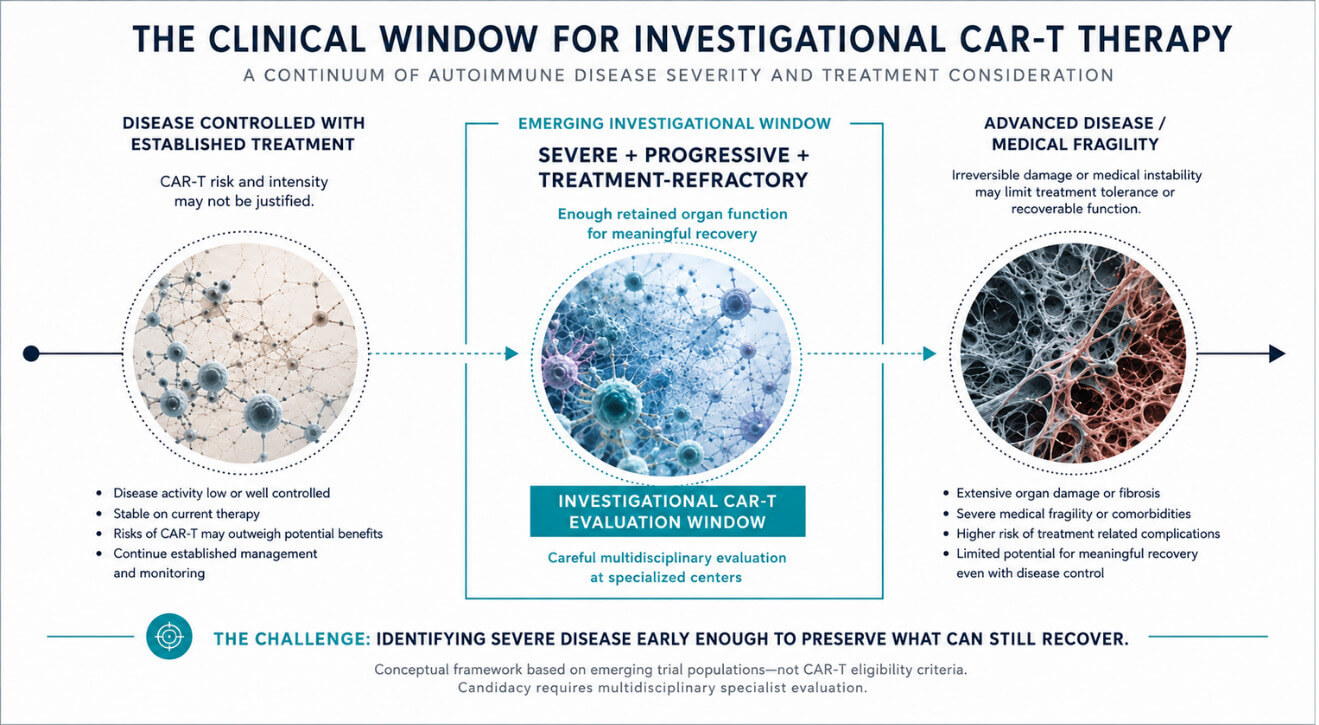
That creates a difficult clinical window.
The Clinical Window for Investigational CAR-T Therapy
Determining who might be appropriate for an intensive cellular therapy requires rheumatology, hematology, immunology and disease-specific expertise.
For functional medicine practitioners, the key role is recognizing when the severity or trajectory of disease warrants collaboration with specialists and academic centers evaluating advanced treatment options — making that referral before irreversible damage accumulates, not after.
The Safety Story Is Encouraging—and Unfinished
The autoimmune CAR-T safety experience has so far been more favorable in some respects than many initially feared from its use in advanced blood cancers.
It is still an intensive therapy.
Patients generally undergo lymphodepletion before receiving their engineered cells. Cytopenias, infections, hypogammaglobulinemia and cytokine release syndrome can occur. Some patients have required IVIG. Serious complications have been reported.
And the longest-term questions remain unanswered.
FDA-approved CD19- and BCMA-directed CAR-T products used in cancer carry warnings concerning secondary T-cell malignancies and require long-term monitoring. The autoimmune cohorts are too small and too new to tell us whether those patients will ultimately carry the same risk, a lower risk or a different risk profile altogether.
For a patient facing years of glucocorticoids, repeated immunosuppression and progressive organ damage, one concentrated period of intensive therapy could eventually prove to be the better tradeoff.
But that is precisely what larger studies and longer follow-up need to establish.
CAR-T May Be the Proof of Concept, Not the Final Product
Today’s CAR-T model is difficult to scale. Cells are collected from an individual patient, genetically engineered, expanded, tested and returned as a personalized product. The process requires specialized manufacturing, multidisciplinary expertise and significant clinical infrastructure.
Researchers are already trying to separate autoimmune cellular therapy from the oncology model in which it was born.
Early studies are investigating donor-derived cells that could potentially become off-the-shelf products, dual immune targets and temporary mRNA engineering that does not permanently modify the cell. A randomized phase 2b study in generalized myasthenia gravis has even tested repeated outpatient infusions of an mRNA CAR-T product without lymphodepleting chemotherapy.
None has established an easy, scalable autoimmune cure.
But they suggest that the first generation of CAR-T may not be the treatment that ultimately matters most.
Its larger contribution may be biological proof of concept: selected immune networks can sometimes be disrupted deeply enough that prolonged disease control follows.
The race now is to discover whether medicine can reproduce that effect with less risk, less complexity and far greater accessibility.
What This Changes for Functional Medicine
CAR-T does not replace the broader functional medicine questions about why immune tolerance was lost in the first place. It adds another layer to the reasoning: what is sustaining the disease now?
CAR-T is a highly targeted cellular therapy being studied in carefully selected patients with severe disease. Its relevance to functional medicine is not that it replaces whole-person care, but that it deepens our understanding of how established autoimmune disease may be maintained.
What the research does is sharpen our clinical reasoning.
Autoimmunity may begin through an interaction among susceptibility, infection, exposure, tissue injury and loss of immune tolerance. Once established, however, the disease may be maintained by immune memory and self-reinforcing cellular networks that no longer depend on the original trigger.
Functional medicine practitioners therefore need to ask both questions:
What may have contributed to the loss of tolerance?
What is sustaining the disease now?
Sometimes the answers will overlap.
Sometimes they won’t.
The discovery of an earlier infection, exposure or physiological stressor can be clinically meaningful without proving that it remains the most important therapeutic target today.
CAR-T adds another dimension to root-cause investigation: identifying the beginning of a disease cannot be the end of the reasoning process.
Refer Earlier When the Trajectory Demands It
Progressive kidney, lung, neurologic, cardiac, vascular or muscular involvement warrants appropriate specialist evaluation, particularly when disease continues to advance despite established treatment.
-
Separate Active Disease From Accumulated Damage
Persistent symptoms can reflect active inflammation, previous tissue injury, treatment effects, deconditioning—or several simultaneously. The distinction should determine what happens next.
Use Precise Language
CAR-T has produced remarkable drug-free remissions. It has not established a cure for autoimmune disease. Patients deserve the hope and the uncertainty.
Coordinate What Comes After
Specialty teams must direct immunologic monitoring and treatment-related care. Functional and primary-care practitioners may have important roles in nutrition, rehabilitation, sleep, cardiometabolic health, mental health and rebuilding function within that coordinated plan.
Four Distinctions That Keep the Story Honest
Response Is Not Remission
A patient can improve meaningfully without reaching an established definition of inactive disease.
-
Remission Is Not Cure
Remission describes the patient’s disease state during a defined period. It cannot tell us with certainty what will happen years later.
Immune Control Is Not Organ Recovery
Stopping autoimmune activity may prevent additional injury without reversing fibrosis, atrophy or established loss of function.
B-Cell Return Is Not Automatically Disease Return
Several cohorts have shown predominantly naïve B-cell repopulation without immediate recurrence of autoimmunity. Whether that persists is one of the field’s most important unanswered questions.
What We’re Watching
The next generation of trials needs to answer what the early studies cannot: How long will drug-free remission last? Which diseases—and which patients within those diseases—are most dependent on B cells or plasma cells? Can biomarkers predict response or relapse? How will cellular therapy compare with the best available standard treatment? Will CD19 depletion be enough for some diseases while others require BCMA or multiple targets?
Just as important is whether researchers can reproduce the effect without reproducing all of the burden. Donor-derived cells, mRNA approaches and future in-vivo engineering may eventually change the economics, manufacturing requirements and risk profile dramatically.
And then there is the question that may matter most clinically: When is the right time to intervene?
Waiting until severe irreversible damage has accumulated may sacrifice much of the benefit remission could offer. Intervening earlier exposes patients to substantial treatment risks when less intensive therapies may still control their disease.
Finding that window may ultimately matter almost as much as finding the right CAR-T target.
“Incurable” Just Got Less Certain
CAR-T has not proved that autoimmune disease is curable. It has shown something narrower—and perhaps more important at this stage: in some carefully selected patients with severe disease, the autoimmune process can be interrupted deeply enough for drug-free remission to persist even after B cells return.
We do not yet know how durable those remissions will be, which patients are most likely to benefit or whether future therapies can reproduce the same biological effect with less risk and complexity. Some patients do not respond. Relapse has occurred. The treatment remains investigational for autoimmune disease.
But the central question has changed.
Autoimmune medicine has long asked how effectively disease can be suppressed and how safely that suppression can be maintained. CAR-T is now asking whether the machinery sustaining autoimmunity can sometimes be dismantled well enough that the same disease state does not immediately rebuild itself.
CAR-T has not proved that autoimmune disease is curable. It has made “incurable” a less certain word.
“CAR-T has not proved that autoimmune disease is curable. It has made ‘incurable’ a less certain word.”
Dr. Z’s Take
What excites me most about this research is not CAR-T itself. It is what CAR-T may be teaching us about autoimmunity.
For years, I have taught practitioners to ask a different question when someone develops autoimmune disease. Instead of stopping at the diagnosis, we want to understand why immune tolerance was lost in this particular person. What was happening before the disease appeared? Were there infections, exposures, changes in the microbiome, metabolic dysfunction, hormonal shifts, nutritional deficiencies, chronic stressors or other factors that may have contributed?
I still think those are enormously important questions. But this research adds another one that I think may be just as important: What started the disease, and what is sustaining it now, may not be the same thing.
That distinction fascinates me.
We tend to think about root causes as though there is something underneath the disease that remains there until we find it and remove it. Sometimes that may be true. But biology is rarely that simple. An infection can resolve. An exposure can disappear. The environment that originally contributed to a loss of immune tolerance can change. Meanwhile, the immune system may have developed memory, cellular relationships and self-perpetuating patterns that continue long after the original event is gone.
CAR-T gives us an extraordinary window into that possibility because researchers are not simply suppressing an inflammatory signal. They are profoundly disrupting selected immune-cell populations and then watching what happens as those populations rebuild.
And what happened in some of these patients is remarkable.
The B cells came back. The autoimmune disease did not automatically come back with them.
I don’t think we should rush past how significant that is. It doesn’t prove that autoimmune disease has been cured. It doesn’t mean every autoimmune condition works the same way, and it certainly doesn’t tell us that every patient will respond. But it challenges the idea that once an immune system has learned autoimmunity, it must inevitably reproduce that same state forever.
That is an incredibly hopeful shift.
It also makes me think differently about what remission could eventually mean. For much of autoimmune medicine, success has understandably meant controlling disease—fewer flares, less inflammation, protection from organ damage and the lowest necessary burden of long-term medication. If researchers can eventually identify which immune networks are perpetuating disease and interrupt them in a durable way, the goal for at least some patients could become something more ambitious than continuous suppression.
CAR-T itself may or may not be how we ultimately get there. The treatment is intensive, the studies are still small and the long-term risks and durability remain unknown. What excites me is the biological proof of concept. If this effect is real and reproducible, the next question becomes whether we can accomplish it more precisely, more safely and for many more people.
There is another piece of this research that I think functional medicine practitioners are uniquely positioned to appreciate. If we become better at stopping the active autoimmune process, our work with the patient doesn’t necessarily end there.
A quiet immune system does not automatically rebuild muscle lost over years of disease. It doesn’t immediately reverse fibrosis, neuropathy, deconditioning, metabolic consequences or the accumulated effects of years of illness and treatment. There may be an enormous opportunity after disease control to help patients rebuild function and health.
That is why I don’t see this research as competing with the way we think in functional medicine. I see it as expanding it.
Keep asking what contributed to the loss of tolerance.
But also ask what is maintaining the disease today.
And if someday we become much better at interrupting that process, ask the next question too: What does this patient need now to recover as much of their health as possible?
We are nowhere near being able to say that autoimmunity is no longer a lifelong disease. But for the first time, researchers are giving us credible reasons to question whether it always has to be.
For millions of patients who have been told some version of you will manage this for the rest of your life, that is a question worth pursuing.
Frequently Asked Questions
Can CAR-T cure autoimmune disease?
No. CAR-T has produced drug-free remission in some patients with severe, treatment-refractory autoimmune disease, but researchers stop short of calling it a cure. Follow-up is measured in months to a few years, cohorts are small, and relapse has occurred.
What is the CASTLE trial?
CASTLE is a 2026 phase 1/2a trial that tested CD19-directed CAR-T therapy in 24 adults with severe, treatment-refractory lupus, systemic sclerosis or inflammatory myopathy. At 24 weeks, 22 of 24 patients reached the study’s predefined efficacy endpoint, and all 24 remained off glucocorticoids and other immunosuppressive treatment.
Do the B cells come back after CAR-T?
Yes. In CASTLE, circulating B cells were undetectable for a median of 83 days before returning. More than 90% of the returning B cells were naïve, and the autoimmune disease did not automatically return with them.
Does the remission always last?
No. A separate 2026 phase 1/2 lupus trial found that 2 of 15 active-disease patients did not respond and one responder later relapsed. In a separate case, a patient with inflammatory myositis relapsed nine months after CD19 CAR-T, and retreatment with the same product failed to restore the response.
What happens when CD19-directed CAR-T stops working?
In one reported case, a patient whose myositis relapsed did not respond to a repeat CD19 CAR-T infusion. Switching to a BCMA-directed CAR-T product, which targets plasma cells rather than B cells, induced remission again.
Does stopping autoimmune activity reverse the damage it already caused?
No. Some CASTLE participants with existing muscle wasting or kidney injury did not fully recover function even after their autoimmune activity was brought under control. Stopping the disease process is not the same as reversing what it already did.
Is CAR-T safe for autoimmune disease?
The safety experience so far has been more favorable in some respects than in cancer patients, though cytopenias, infections, hypogammaglobulinemia and cytokine release syndrome can occur. Every FDA-approved CD19- and BCMA-directed CAR-T product carries a boxed warning for secondary T-cell malignancies, and the long-term risk in autoimmune patients specifically is not yet known.
Who is eligible for autoimmune CAR-T therapy today?
It remains investigational and reserved for patients with severe, progressive disease that has failed multiple standard treatments. In CASTLE, enrolled patients had a median disease duration of four years and had already failed a median of four immunosuppressive regimens.
What role should functional medicine play with CAR-T patients?
Not treating autoimmune disease directly in most cases — scope, licensure and disease severity still matter. The practical role is recognizing when disease trajectory warrants earlier referral to rheumatology or specialist centers, and coordinating nutrition, rehabilitation, sleep and mental-health care alongside specialist-directed immunologic treatment.
Sources
Müller F, Taubmann J, Bucci L, et al. “CD19 CAR T-Cell Therapy in Autoimmune Disease — A Case Series with Follow-up.” New England Journal of Medicine, 2024;390(8):687–700. https://www.nejm.org/doi/full/10.1056/NEJMoa2308917
Müller F, et al. “CD19 CAR-T Cells for Treatment-Refractory Autoimmune Diseases: The Phase 1/2 CASTLE Basket Trial.” Nature Medicine, 2026;32(3):1142–1151. https://www.nature.com/articles/s41591-025-04185-6
“Autologous CD19 CAR-T Cell Therapy for Pediatric and Adult Systemic Lupus Erythematosus: A Phase 1/2 Trial.” Molecular Therapy, 2026. https://www.sciencedirect.com/science/article/abs/pii/S1525001626002649
Müller F, et al. “BCMA CAR T Cells in a Patient with Relapsing Idiopathic Inflammatory Myositis After Initial and Repeat Therapy with CD19 CAR T Cells.” Nature Medicine, 2025;31:1793–1797. https://www.nature.com/articles/s41591-025-03718-3
“Co-Infusion of CD19-Targeting and BCMA-Targeting CAR-T Cells for Treatment-Refractory Systemic Lupus Erythematosus: A Phase 1 Trial.” Nature Medicine, 2025. https://www.nature.com/articles/s41591-025-03937-8
U.S. Food and Drug Administration. “FDA Requires Boxed Warning for T Cell Malignancies Following Treatment with BCMA-Directed or CD19-Directed Autologous Chimeric Antigen Receptor (CAR) T Cell Immunotherapies.” April 18, 2024. https://www.fda.gov/vaccines-blood-biologics/safety-availability-biologics/fda-requires-boxed-warning-t-cell-malignancies-following-treatment-bcma-directed-or-cd19-directed
“BCMA-Directed mRNA CAR T Cell Therapy for Myasthenia Gravis: A Randomized, Double-Blind, Placebo-Controlled Phase 2b Trial.” Nature Medicine, 2026. https://www.nature.com/articles/s41591-025-04171-y
Subscribe
Subscribe for free to get the latest insights in your inbox every week.