
The $99 Membership Lie

By The Functional Medicine Report™
Originally published August 14, 2026 in Issue #005 of The Functional Medicine Report™
Low-cost memberships are being sold as the simplest path to recurring revenue. But when we followed the numbers all the way through, a different picture emerged.
Key Takeaways
- At $99 a month it takes 202 members to reach roughly $20,000 in monthly gross revenue. At $2,500 per clinical program it takes eight. Identical revenue, entirely different business.
- Revenue is only half the equation. Before a dollar becomes profit there is payment processing, software, staffing, support, content production and — most overlooked — the cost of acquiring each member.
- Recurring revenue only recurs if members renew. In the article’s modelled scenario, 202 members at 13% monthly churn lose about 26 people a month, costing roughly $8,500 in replacement acquisition just to stand still.
- Low price forces volume, and volume changes clinical behaviour. Functional medicine earned its reputation by slowing down; a model that needs hundreds of members pulls in the other direction.
- Memberships work best after the intensive clinical work rather than instead of it. Then the membership maintains a relationship instead of having to create one.
Spend a few minutes scrolling through social media and you’ll almost certainly see it: the promise that a $99-a-month membership can transform a healthcare practice.
The pitch is familiar. Charge a small monthly fee. Build predictable recurring revenue. Stop relying on one-off appointments. Help more people while creating a business that finally feels stable.
For practitioners, it’s an appealing idea. Functional medicine is time-intensive by design, and recurring revenue offers something every practice wants: predictability. Instead of starting each month at zero, revenue compounds as members continue to renew.
There’s only one problem.
Almost every conversation starts with the price and ends with the revenue. Very few continue to the operational reality that sits between those two numbers.
How many members does it actually take to build a meaningful business? What does it cost to acquire them? How many leave before they’ve experienced enough value to stay? And at what point does a solo practitioner stop running a clinical practice and start running a media company, a customer support department and a software platform all at once?
Those questions matter because functional medicine isn’t simply another subscription business. It depends on individualized thinking, detailed history taking, laboratory interpretation and long-term relationships. A membership isn’t just selling information. At some point, it has to support the clinical promise behind it.
So rather than ask whether a $99 membership sounds attractive, we asked a different question:
What happens when you follow the math all the way to the end?
Behind the Business Model
One of the first surprises had nothing to do with memberships themselves. It came from looking at the people teaching practitioners how to build them.
Many of the most visible voices promoting the $99 model aren’t primarily operating $99 businesses. Instead, they’re selling premium consulting, coaching or implementation programs—often priced between $15,000 and $20,000—that teach other practitioners how to launch a low-cost membership.
That observation doesn’t automatically invalidate the strategy. Plenty of successful business owners teach what they’ve learned. But it does raise an important question: if the low-cost membership is such a remarkable business model, why isn’t it the primary business for the people selling it?
The answer may be that they’re running two very different companies.
One is a mature business with an established audience, sophisticated marketing, experienced staff and years of operating capital. The other is the business being presented to practitioners who may have none of those advantages. A clinician launching their first membership isn’t starting with a media department, a customer service team or a seven-figure advertising budget. They’re starting with clinical expertise and the hope that recurring revenue will create stability.
That distinction matters because advertisements rarely show the infrastructure behind the promise. They don’t show the acquisition costs, the technology stack, the customer support workload or the constant effort required to replace members who leave. Those details aren’t nearly as exciting as a screenshot of monthly recurring revenue, but they’re often what determine whether the business succeeds.
Which led us to a more interesting question.
Perhaps the real product being sold isn’t a $99 membership at all.
Perhaps it’s the idea that a $99 membership is an easy business to build.
If that’s true, the first place to look isn’t the marketing.
It’s the math.
The Math Changes Faster Than Most Practitioners Realize
Let’s set aside marketing for a moment and look at a simple business goal.
Imagine a practitioner wants to generate approximately $20,000 a month in gross revenue. Nothing extravagant—just a healthy, sustainable practice.
How many patients would they need?
That answer depends almost entirely on price.
| OFFER | PATIENTS OR MEMBERS NEEDED |
|---|---|
| $5,000 clinical program | 4 |
| $2,500 clinical program | 8 |
| $99 monthly membership | 202 |
At first glance, the comparison doesn’t seem alarming. Two hundred two members sounds achievable, especially in an online business.
Until you stop thinking about revenue and start thinking about people.
Four clinical patients require four treatment plans.
Two hundred two members require an operating system.
Someone has to answer billing questions. Someone has to manage failed credit cards, password resets, onboarding emails, community moderation, replay uploads and support requests. Someone has to create new content every month, monitor engagement and keep members from quietly drifting away.
Those responsibilities don’t replace clinical care. They sit on top of it.
By the time a practice reaches a few hundred members, it has begun solving a very different problem. The practitioner isn’t simply asking, “How do I help this patient?” They’re also asking, “How do I consistently serve hundreds of people without the business collapsing under its own operational weight?”
That isn’t necessarily a bad business.
Many companies operate successfully at that scale.
But it is a fundamentally different business than most practitioners believe they’re building when they first see a $99 membership advertisement.
Revenue Is Only Half the Equation
Membership businesses are almost always presented in terms of recurring revenue.
Understandably so. Monthly recurring revenue is easy to visualize, easy to celebrate and looks impressive on a sales page.
Expenses rarely receive the same attention.
Before a single dollar becomes profit, the business still has to pay for payment processing, software, technology, staffing, customer support, marketing and content production. Then there’s the cost that’s often overlooked entirely: acquiring the members in the first place.
Every membership begins with a person who has to discover you, trust you and decide to join.
Some practitioners can build an initial membership through an existing patient base, referrals or an engaged email list. Others rely heavily on paid advertising. Most businesses eventually use some combination of both.
That’s where the economics begin to change.
For illustration, assume a paid customer acquisition cost of $325 per member. Actual costs vary widely depending on the offer, audience, creative, platform and sales funnel, but the exercise illustrates an important principle.
Acquiring 100 members would require roughly $32,500 in marketing investment.
Acquiring 202 members would require approximately $65,650.
And that assumes you’re filling the membership for the first time.
It says nothing about the members who leave next month.
Because recurring revenue only stays recurring if members continue renewing.
That’s where the conversation shifts from acquisition…
…to retention.
When Members Start Leaving
Recurring revenue sounds predictable.
People aren’t.
Every membership business eventually reaches the same moment: members begin to leave. The only questions are how many, how quickly and how expensive they are to replace.
That’s why churn deserves more attention than it usually receives.
It’s also why practitioners should be careful not to treat every type of member loss as though it’s the same.
Some people purchase and never truly engage. Others leave after the first few billing cycles because they haven’t experienced enough value to justify another payment. Still others disappear when an introductory offer or promotional pricing expires. Those situations are often grouped together under the single word churn, even though they reflect very different business problems.
Understanding those differences matters because each one requires a different solution.
A member who never logs in has an onboarding problem.
A member who leaves after three months may have a value or engagement problem.
Someone who exits after a promotional period may simply have reached the end of the offer they intended to buy.
Lumping those behaviors together makes the numbers harder to interpret—and the business harder to improve.
What they all have in common is this: every departing member represents revenue that has to be replaced.
Consider one modeled scenario.
A membership has 202 active members and experiences 13% monthly churn. That means roughly 26 members leave during the month. If replacing each member requires an assumed acquisition cost of $325, the practice spends approximately $8,500 simply replacing the people who left.
Nothing has grown.
The business has invested thousands of dollars just to return to where it started.
That changes the way recurring revenue should be viewed.
The monthly subscription isn’t simply generating income. Part of that income is constantly being reinvested into replacing members who are no longer there.
The launch numbers may look impressive.
The renewal numbers determine whether the business is actually growing.
Recurring Revenue—or Recurring Replacement?
This is where the economics begin to shift.
Practitioners are often taught to focus on Monthly Recurring Revenue (MRR). It’s an important metric, but by itself it can create a false sense of momentum.
A membership can report growing recurring revenue while quietly spending an increasing amount of money just to replace the members it keeps losing.
That’s not compounding.
That’s maintenance.
Imagine trying to fill a bucket with a hole in the bottom.
You can keep pouring water in, and the bucket may even appear full for a while. But unless the leak slows, you’ll spend the rest of your time replacing what has already disappeared.
Membership businesses work the same way.
The more members who leave, the more acquisition becomes a permanent operating expense rather than an engine for growth.
That’s why experienced subscription companies obsess over retention. Every percentage point of improvement reduces the pressure to acquire new customers and increases the lifetime value of the ones already enrolled.
The principle is no different in healthcare.
A practice that retains patients longer needs fewer new patients to produce the same revenue. A practice with heavy turnover must continually replace people simply to stand still.
For functional medicine practitioners, that distinction is especially important because patient relationships aren’t built overnight. They require trust, education, clinical reasoning and time. Every member who leaves early represents more than lost revenue—it represents a relationship that never had the opportunity to mature.
Which raises another question rarely addressed in the advertisements.
If keeping members is this important, what exactly are they being asked to stay for?
That brings us to the part of the conversation where the economics and the clinical reality finally meet.
The Clinical Problem No One Is Pricing
Even if the business model worked perfectly, one question would still remain.
Can functional medicine realistically begin inside a $99-a-month membership?
That depends on what the membership is promising.
If it’s an educational community—a place where people learn about nutrition, lifestyle medicine, laboratory science or chronic illness—it can be an excellent resource. Expectations are clear, and the value comes from education rather than individualized care.
Functional medicine is different.
A patient rarely arrives with one isolated problem. They arrive with years of history, multiple diagnoses, medications, previous testing, unanswered questions and symptoms that often span several body systems. Before meaningful recommendations can be made, someone has to connect those dots.
That work takes time.
It requires careful history taking, thoughtful laboratory interpretation, pattern recognition and clinical judgment. It also requires a relationship. The practitioner isn’t simply delivering information; they’re learning how this particular patient became this particular patient.
A $99 front-end membership is being asked to do all of that before the practitioner has even had the opportunity to understand who is sitting in front of them.
Something eventually has to give.
The practitioner increases volume.
The care becomes more standardized.
Or the individualized work moves outside the membership and into additional paid services.
None of those approaches is inherently wrong—as long as patients understand what they’re buying.
The difficulty begins when a low-cost membership is marketed as though it can replace the depth of individualized functional medicine rather than complement it.
When Volume Starts Driving Clinical Decisions
Price doesn’t just influence revenue.
It influences behavior.
A practitioner charging $99 a month has one obvious path to growth: enroll more members. That’s simple economics.
The challenge is that clinical complexity doesn’t become easier as volume increases. It becomes harder to manage consistently.
Every additional member brings new questions, new emails, new laboratory results, new supplement concerns and new requests for guidance. Even when a membership is positioned as education rather than medical care, patients naturally ask individual questions about their own health.
Those conversations require boundaries.
What belongs inside the membership?
What requires an individual appointment?
What creates a patient-provider relationship?
Where does education end and clinical care begin?
Those aren’t just operational questions. They’re professional ones.
As volume grows, so does the importance of having clear systems, defined expectations and a delivery model that respects both clinical quality and scope of practice.
There’s another concern that deserves equal attention.
Many practitioners are encouraged to scale before they’ve fully developed confidence in clinical reasoning. Volume amplifies everything—including uncertainty. A difficult case doesn’t become easier because it’s happening inside a membership. If anything, the pressure to move quickly can make complex clinical decisions even more challenging.
Functional medicine has earned its reputation by slowing down, asking better questions and looking beyond protocols.
A business model should support that philosophy—not quietly pull practitioners away from it.
The Business You Didn’t Mean to Build
Most practitioners don’t launch a membership because they want to build a technology company.
They launch one because they want a better clinical practice.
They want steadier revenue, fewer financial ups and downs and more continuity with their patients. Those are reasonable goals. In fact, they’re some of the biggest advantages a well-designed membership can offer.
But as membership numbers grow, the work begins to change.
Patients expect onboarding that works. Passwords need to be reset. Credit cards expire. Community discussions require moderation. Live calls have to be scheduled, recorded and uploaded. Emails need to be written. New educational content has to appear consistently. Someone has to answer questions when the practitioner is with patients—or simply taking a day off.
None of those responsibilities are unusual. They’re part of running a successful membership.
The surprise is how quickly they become the dominant workload.
At a few dozen members, most practitioners can manage the administrative side themselves.
At a few hundred, that approach begins to break down.
The business now needs operations, customer support, content production, technology management and marketing systems that continue running whether the practitioner is in clinic, on vacation or unexpectedly away from work.
That’s no longer just a clinical practice.
It’s an operating company.
For practitioners who intentionally want to build a media brand or education platform, that may be exactly the right direction.
For those who simply wanted more predictable income, it can come as an expensive surprise.
The lesson isn’t that memberships create complexity.
It’s that scale creates complexity, and low-ticket pricing often requires scale long before most practitioners realize they’re building toward it.
The Upsell Isn’t a Business Model
One of the most common responses to the economics of a $99 membership is straightforward:
“The membership isn’t where you make the money. You upsell people later.”
Sometimes that’s true.
The problem is assuming it will happen automatically.
The people who purchase a $99 offer are often different from the people who begin with a comprehensive clinical program. Some are exploring. Some are curious. Some genuinely can’t afford higher-priced care. Others simply aren’t ready to commit.
That’s why a low-ticket membership shouldn’t be viewed as a guaranteed pipeline into premium services.
Some members will absolutely choose to continue their care.
Many won’t.
And that’s perfectly acceptable—as long as the business wasn’t built on the assumption that they would.
There’s another challenge that receives far less attention.
Price communicates positioning.
When the first interaction with a practitioner is a $99 offer, that price begins shaping the perceived value of everything that follows. Transitioning someone from a low-cost membership into a multi-thousand-dollar clinical program isn’t impossible, but it requires rebuilding the conversation around value rather than simply presenting a higher price.
The strongest practices don’t rely on an upsell to rescue weak unit economics.
They design a business that works before a single patient ever upgrades.
Any future clinical program becomes exactly what it should be: an opportunity for the right patient at the right time—not the financial strategy holding the entire business together.
Where Memberships Actually Belong
By this point, you might think this article is arguing against memberships.
It isn’t.
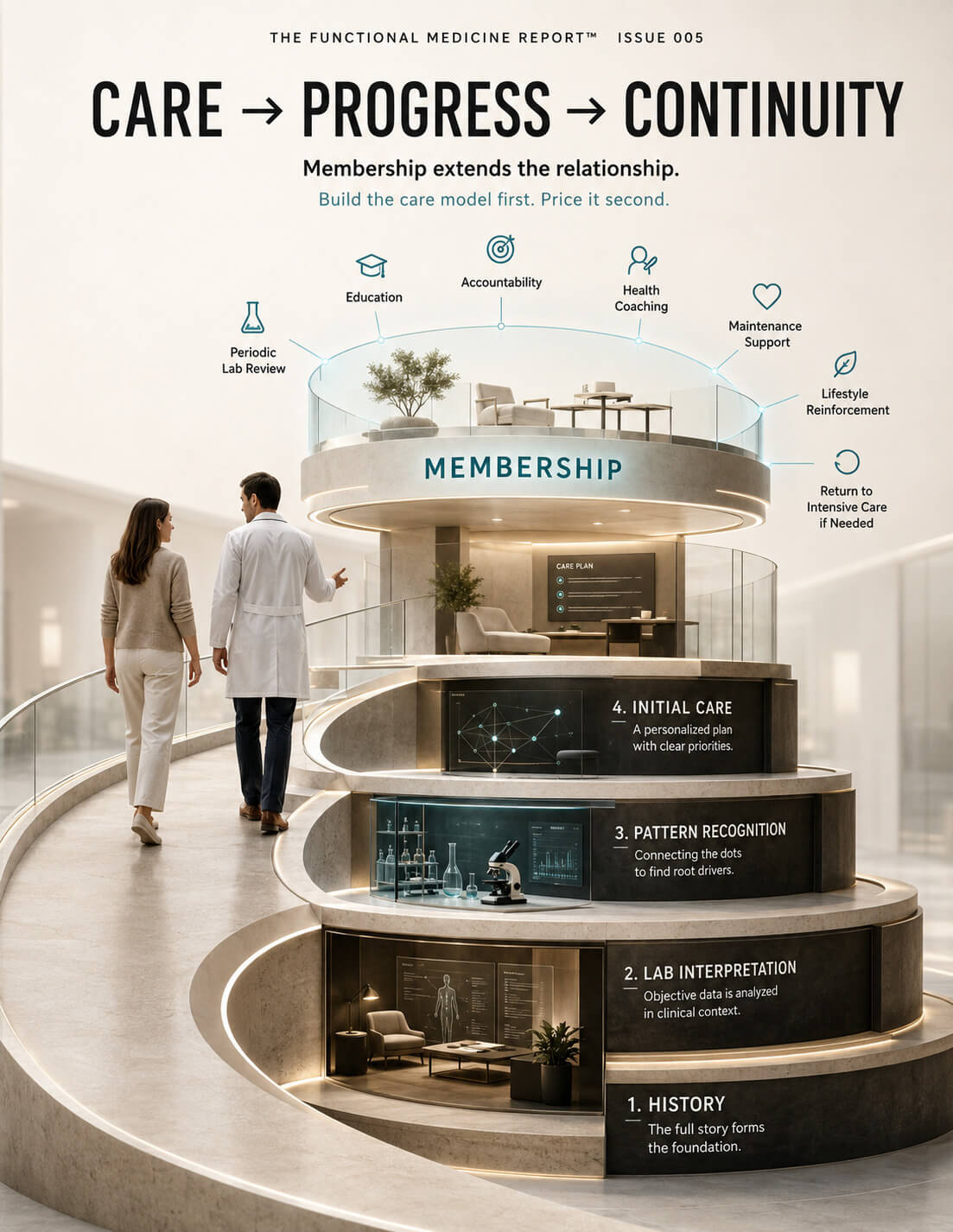
Recurring revenue can strengthen a practice. Ongoing support can improve continuity. Many patients benefit from having a structured way to stay connected after the most intensive phase of care is over.
The question isn’t whether memberships work.
It’s where they belong in the patient journey.
A front-end membership asks a low monthly fee to do almost everything. It has to attract new patients, build trust, uncover years of history, educate, create meaningful clinical progress and convince someone to continue paying—all before the practitioner truly understands the case.
That’s an enormous amount to ask from any business model.
Now compare that with a membership that begins after the heavy lifting has already been done.
The history has been taken.
The laboratory testing has been reviewed.
Patterns have been identified.
Initial interventions have been implemented and refined.
The practitioner understands the patient’s story, and the patient understands the practitioner’s approach.
The relationship already exists.
At that point, the purpose of the membership changes completely.
Instead of creating the relationship, it’s maintaining one.
Instead of trying to solve every problem, it’s helping patients protect the progress they’ve already made.
That might include periodic laboratory reviews, group education, health-coach support, accountability, maintenance strategies, lifestyle reinforcement or a clear pathway back into more intensive care when needed.
The operational burden changes because the clinical foundation is already in place.
The practitioner isn’t starting from zero with every new member.
They’re continuing a conversation that’s already underway.
Just as importantly, patients who’ve already invested time, energy and resources into their care are often making a different decision than someone purchasing a $99 offer from an advertisement. They’ve experienced the process. They’ve seen the value. They’re choosing continuity rather than curiosity.
That doesn’t eliminate cancellations or make retention effortless.
But it changes the economics, the expectations and the clinical relationship in meaningful ways.
Membership isn’t replacing functional medicine.
It’s extending it.
Build the Care Model First. Price It Second.
One of the easiest mistakes practitioners make is starting with a number.
“I think people would pay $99 a month.”
“Maybe $149 feels too expensive.”
“Everyone else seems to charge…”
Those conversations happen long before a more important one.
What, exactly, is this membership supposed to do?
A better place to begin is with the patient—not the price.
What stage of care are they in?
What support do they actually need after the intensive work is complete?
Which parts of that support require the practitioner’s expertise, and which can be delivered through education, coaching or well-designed systems?
Only after those questions are answered does pricing begin to make sense.
The fee shouldn’t be determined by what feels marketable.
It should reflect what the practice has committed to delivering consistently, safely and profitably.
That includes practitioner time, team support, technology, communication, follow-up, content creation and the operational infrastructure required to make the experience reliable for every patient—not just the first twenty.
A membership that’s priced too low doesn’t simply reduce profit.
It often changes the care itself.
The practice begins looking for ways to fit the work inside the fee instead of pricing the fee around the work.
That’s rarely good for the practitioner, and it’s rarely good for the patient.
The strongest membership models don’t begin with a price point.
They begin with a clearly defined purpose.
The price follows from there.
The Real Question
By now, the debate isn’t really about whether memberships work.
They do.
The better question is what role they’re being asked to play.
If a membership is expected to attract strangers, earn trust, gather a complex health history, deliver meaningful clinical guidance, produce measurable results and generate sustainable profit—all for $99 a month—it’s carrying an extraordinary amount of responsibility.
Not because memberships are flawed.
Because that’s simply too many jobs for one product.
The strongest practices tend to separate those jobs instead of combining them.
They use an intensive clinical process to understand the patient, identify the major drivers and create meaningful progress. Only after that foundation has been built does a membership become a logical next step—supporting continuity, accountability, education and long-term maintenance.
The sequence matters.
Patients don’t remain because they’re paying a monthly fee.
They remain because they’ve experienced value.
That’s a very different kind of retention.
For practitioners, the same principle applies.
A membership shouldn’t be built because recurring revenue sounds attractive. It should be built because it makes clinical sense, fits the way the practice delivers care and creates a better experience for both patients and the team.
The price comes later.
The care model comes first.
Perhaps that’s the biggest lesson hidden behind the $99 membership conversation.
The advertisements start with a number.
Successful practices start with a patient.
And those are two very different ways to build a business.
FAQ
About 202. The same $20,000 requires four patients on a $5,000 clinical program or eight on a $2,500 program. The revenue is identical; the operational load is not. Four patients need four treatment plans. Two hundred members need an operating system.
It depends entirely on the job it is being asked to do. As an educational community with clear expectations it can work well. As a front-end offer expected to attract strangers, build trust, gather a complex history and produce clinical progress, it is carrying too many jobs for one product.
It varies widely by offer, audience, creative, platform and funnel. The article models $325 per member for illustration. On that assumption, filling 202 places costs roughly $65,650 before a single member has renewed — and that figure says nothing about replacing the ones who leave next month.
Because several different problems get grouped under one word. A member who never logs in has an onboarding problem. One who leaves at three months may have a value or engagement problem. Someone exiting after a promotional period simply reached the end of the offer they meant to buy. Each needs a different fix.
A membership can report growing monthly recurring revenue while spending steadily more just to replace the members it keeps losing. That is not compounding, it is maintenance — filling a bucket with a hole in the bottom. Acquisition becomes a permanent operating expense rather than an engine for growth.
The work that functional medicine depends on — detailed history taking, laboratory interpretation, pattern recognition, clinical judgment and a relationship — takes time. A $99 front-end membership is asked to do all of it before the practitioner understands who the patient is. Something has to give.
Not automatically. People who buy a $99 offer are often different from those who start with a comprehensive program — exploring, curious, or not ready to commit. Price also communicates positioning, so moving someone to a multi-thousand-dollar program means rebuilding the conversation around value, not just raising the number.
After the intensive work, not before it. Once the history is taken, labs reviewed, patterns identified and initial interventions refined, the relationship already exists. The membership then maintains progress rather than trying to create the relationship from zero with every new member.
Sources
The article currently cites nothing. Its two load-bearing numbers — $325 acquisition cost and 13% monthly churn — are properly flagged as modelled, but they will be extracted and quoted as data. These four give them a benchmark to sit against. Additions, so they need Dr. Z’s approval.
- Recurly, “Churn rate benchmarks: SaaS, media, retail and more industries” — network data across 2,200 merchants and 76 million subscribers. https://recurly.com/research/churn-rate-benchmarks/
- SubJolt, “Churn Rate Benchmarks by Industry (2026)” — compiled from Recurly, Churnkey, ChartMogul and Paddle. https://www.subjolt.com/guides/churn-rate-benchmarks/
- Eightx, “Average Subscription Churn Rate by Category” — category benchmarks and retention curves. https://eightx.co/blog/average-subscription-churn-rate-by-category
- Finsi, “E-commerce Churn Rate Benchmarks by Industry (2026)” — on how monthly churn compounds annually. https://www.finsi.ai/blog/ecommerce-churn-rate-benchmarks-2026/
Subscribe
Subscribe for free to get the latest insights in your inbox every week.