
The Peptide Crossroads

Why the FDA meeting isn’t the biggest peptide story of the year.
By Dr. Brandy Zachary, DC, IFMCP, FMACP
Originally published July 17, 2026 in Issue #001 of The Functional Medicine Report™
Key Takeaway
The Pharmacy Compounding Advisory Committee doesn’t approve peptides. It doesn’t ban peptides. Its role is to review available evidence and make recommendations to the FDA regarding whether specific substances should be included on the 503A Bulks List, which may influence future compounding decisions.
This isn’t really a peptide story. It’s a story about what happens when science moves faster than regulation-and what that means for practitioners trying to do the right thing.
Everyone’s watching Washington. That’s understandable.
On July 23-24, the FDA’s Pharmacy Compounding Advisory Committee will review several high-profile peptides, and if social media is any indication, you’d think the future of peptide medicine hangs on those two days. It doesn’t.
Yes, the meeting matters. Yes, the recommendations matter. But many read this as “about to be approved” and the FDA has already released statements ahead of the fact against that.
Current issues is true clinical research is only approved legal use. Must be IRB-approved clinical trial and patients enroll as research participants, not as routine clinical patients.
Meanwhile, practitioners and direct-to-consumer supply companies are using “research grade peptides” not intended for patients. Regulators are concerned.
The bigger story actually started a few months ago, quietly… in Alabama. Alabama said “NO” that it’s illegal to use outside of an IRB and informed consent does not absolve this.
This isn’t really a peptide story. It’s a story about practicing medicine when science moves faster than regulation.
-Dr. Z
Most Practitioners Are Asking the Wrong Question
When a new therapy appears, our minds naturally go here first: Does it work? Is it safe? Would it help?
Those are good questions. They’re just no longer enough. Today, practicing medicine requires another layer of thinking: Your license. Your scope of practice. Your malpractice coverage. Your state’s regulations. The current standard of care.
Those issues don’t determine whether something works. They determine whether you’re allowed to use it.
That’s an entirely different conversation.
Related resource: Join the Functional Medicine 2.0 community
The Six Layers of Practitioner Risk
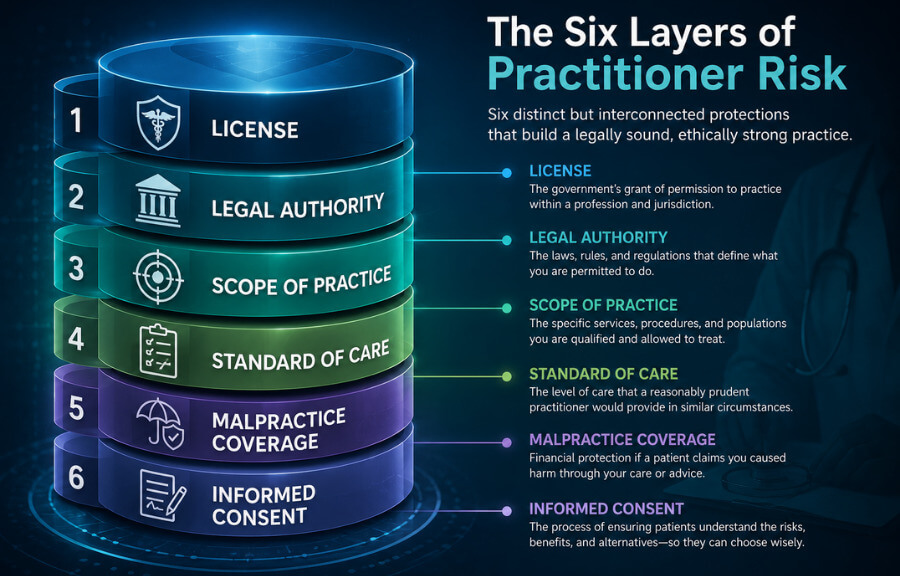
Six distinct but interconnected protections that build a legally sound, ethically strong practice.
- LICENSE
The government’s grant of permission to practice within a profession and jurisdiction. - LEGAL AUTHORITY
The laws, rules, and regulations that define what you are permitted to do. - SCOPE OF PRACTICE
The specific services, procedures, and populations you are qualified and allowed to treat. - STANDARD OF CARE
The level of care that a reasonably prudent practitioner would provide in similar circumstances. - MALPRACTICE COVERAGE
Financial protection if a patient claims you caused harm through your care or advice. - INFORMED CONSENT
The process of ensuring patients understand the risks, benefits, and alternatives-so they can choose wisely.
What Is the FDA Actually Doing?
Let’s clear up one of the biggest misconceptions.
The Pharmacy Compounding Advisory Committee doesn’t approve peptides. It doesn’t ban peptides. Its role is to review available evidence and make recommendations to the FDA regarding whether specific substances should be included on the 503A Bulks List, which may influence future compounding decisions.
The FDA may accept those recommendations. It may reject them. It may modify them. Nothing automatically changes the day the meeting ends. Understanding that distinction helps practitioners respond to facts rather than headlines.
The Story More People Should Be Talking About
While everyone’s attention has been focused on Washington…Alabama quietly changed the conversation.
Earlier this year, the Alabama Board of Medical Examiners and the Alabama Medical Licensure Commission issued a formal notice stating that physicians may not prescribe, administer, dispense, or compound research-grade peptides.
One sentence in that notice deserves far more attention than it has received.
Patient waivers do not provide legal protection.
Think about that for a second. Many clinicians understandably assume that if patients understand the risks and willingly consent, they’re protected. Consent absolutely matters.
But consent isn’t the same as legal authority. It isn’t the same as scope of practice. It isn’t the same as malpractice coverage. And it certainly isn’t the same as the standard of care. Those are separate layers of professional responsibility.
Peptides won’t be the last therapy to occupy a regulatory gray zone. They’re simply one of the first. And that’s exactly why this story deserves more attention than it has received.
Science Is Moving Faster Than the Rules
That’s the real headline. Patients now learn about therapies from podcasts, YouTube, online communities, and social media long before they hear about them in the clinic. Researchers publish early findings. Companies launch products.
Clinicians become interested. Patients begin asking questions. Only then do regulators determine how these therapies fit into existing frameworks – that creates a gap.
Not because someone is necessarily doing something wrong. Because innovation and regulation move at different speeds.
Here’s what practitioners often miss…
Living in that gap creates responsibilities that didn’t exist twenty years ago. Understanding those responsibilities may become one of the most valuable clinical skills of the next decade.
Now what?
Don’t just ask whether an emerging therapy works. Ask whether you’re prepared to practice responsibly within today’s regulatory landscape.
Clinical Judgment Still Matters
None of this means we should stop thinking. Quite the opposite. Medicine has always required thoughtful clinical judgment. Protocols matter. Evidence matters. Guidelines matter. But patients don’t always read the textbook. Sometimes the algorithm doesn’t tell the whole story.
That’s why experienced clinicians learn to combine standards with judgment-not substitute one for the other. The goal isn’t choosing between science and critical thinking. The goal is practicing both.
Two Things Can Be True
Regulation exists because patients deserve protection. Poor-quality products deserve scrutiny. Bad actors deserve consequences. All of that is true.
It’s also true that clinicians need enough professional autonomy to care for patients as individuals.
Those ideas shouldn’t compete, they should complement one another. The buzz in the functional medicine industry is practitioners are feeling like they have to choose between what the patient needs and what the law allows.
A Framework You’ll Use Again
Whether the next controversy involves peptides, stem cells, AI, microbiome therapies, or something we haven’t heard about yet, the questions remain remarkably consistent.
Ask yourself:
- What does the evidence actually say?
- What does my state allow?
- What does my license allow?
- Does my malpractice coverage align with my decisions?
- Have I confused patient consent with legal authority?
Those questions may not be exciting, but they may be the most valuable questions you’ll ask all year.
Bottom Line
The peptide debate won’t last forever. Another therapy will replace it. Another gray area will emerge. The clinicians who thrive won’t necessarily be the first to adopt every innovation. They’ll be the ones who develop a reliable framework for thinking through uncertainty.
Because that’s the real skill. Not memorizing the next therapy. Learning how to evaluate it. And that’s a skill you’ll use long after today’s headlines have faded.
Dr. Z’s Take
The longer I’ve sat with this peptide story, the more I’ve realized it isn’t really changing my mind about peptides. It’s making me think about regulation.
Currently peptides are in a “no man’s land” of not a prescription and not a supplement. Do YOU really want to be the first legal test case to battle it out in the courts?
Because I don’t think this conversation ends with peptides. I think they’re simply exposing a challenge we’re going to see over and over again as healthcare evolves.
Science is moving quickly. Patients are learning about new therapies faster than ever. Regulations are trying to keep up.
Meanwhile, practitioners are sitting in the middle, trying to figure out how to help the person in front of them without putting their license-or their livelihood-at risk.
That’s a hard place to practice. One sentence in the Alabama guidance kept sticking with me.
The notice made it clear that having a patient sign a waiver doesn’t create legal protection.
I suspect a lot of clinicians read that sentence and immediately moved on.
I wouldn’t.
It highlights something I think many practitioners unintentionally blur together.
- Informed consent.
- Scope of practice.
- Legal authority.
- Malpractice coverage.
They’re related, but they aren’t interchangeable. Understanding the difference is part of being a responsible clinician today.
As I was thinking about that, another story came to mind that had nothing to do with peptides.
It involved a physician who developed life-threatening bleeding after what should have been a routine colonoscopy.
He knew something was wrong. He was losing blood. He kept telling the emergency department he didn’t feel right.
The team wasn’t careless. They were following the standard they had been taught. One of the key markers they were watching-his heart rate-never rose the way they expected it would.
What they didn’t recognize (because they wouldn’t listen to him) was that he was an athlete. His normal resting pulse was already much lower than average. The protocol fit the guideline, but it didn’t fit the patient.
By the time a repeat colonoscopy was finally performed, the delay had changed the course of his life.
He survived. But surviving wasn’t the whole story.
He lost so much blood that he eventually had to close his practice. He wasn’t even able to work long enough to sell it. Everything he had spent years building disappeared because of one delayed decision.
I think about that story often because it’s uncomfortable.
The standards that protect patients every day also have limitations.
That doesn’t mean we abandon standards. Far from it. It means we never stop thinking. Maybe that’s why this peptide conversation feels so much bigger to me.
The question isn’t simply whether regulators should regulate. Of course they should.
The question is how do we protect patients while also leaving room for thoughtful clinicians to care for the individual sitting in front of them? Especially when that individual doesn’t fit neatly inside the algorithm.
I don’t know that there’s a perfect answer. I honestly don’t think there is. But I think asking that question is healthier than pretending the tension doesn’t exist.
I’ve trained thousands of practitioners of every license so people sometimes ask me where I land personally.
The answer is actually pretty straightforward. As a clinician, I stay inside the legal box.
I’ve spent years working with outstanding healthcare attorneys because I believe it’s my responsibility to dot every “i,” cross every “t,” and make sure my practice is legally and ethically sound. That’s part of practicing medicine responsibly in the United States. Following the rules has never prevented me from getting great results for patients. It has challenged me to become a better clinician.
If there’s a therapy I believe may help someone, but it’s outside my legal scope or isn’t something I’m permitted to provide, I don’t pretend it doesn’t exist.
I explain exactly what I can and cannot do. Then, if it’s appropriate, I help that patient understand where they might learn more or who is legally able to provide that care. I can advocate for patients without stepping outside the rules. To me, those two things belong together.
My personal healthcare is different. As a patient, I’ve traveled outside the United States for treatments that weren’t available here or weren’t yet legally accessible.
I recognize not everyone has that opportunity, and that’s part of what makes this conversation so difficult. Access isn’t equal. Regulations aren’t the same everywhere. Patients often find themselves navigating a very different reality than clinicians.
That experience has made me more empathetic-not less compliant.
It’s reminded me what it feels like to be the person searching for answers.
And I know it’s not “fair”. I get to be on different sides of the fence. I can teach practitioners about peptides and tell them – go talk to your attorney if you want to use them, but I don’t suggest being that first test legal case.
Personally, I don’t mind pushing the boundaries but only if there is legal precedent – meaning someone else has already fought the legal battle, or the tax law or whatever the topic may be. Yes its’s a conservative stance, but it has served me well and I have an army of attorneys.
I tell my practitioners the most important thing is that you continue to stay open – because you are no good to anyone if your practice is closed.
And then we have to balance that with what is beneficial for the patient.
The not “fair” part is that I know all too well what it means to languish with complex health issues and not find the answers in traditional medicine and sometimes not even with my fourth functional medicine practitioner. My search for answers has taken me to many U.S teaching hospitals (Harvard, Princeton, Stanford, UCSF) and chasing down physicians and researchers around the world. I’ve received treatments out of the country that I can’t get in the United States.
I worked really hard to be able to have that access and I know most just can not pull it off. So what do we do?
The next debate probably won’t be about peptides. It’ll be stem cells. Or AI. Or gene editing. Or something not yet on our radar…
How are you navigating the peptide crossroads?
-Dr. Z
Peptides to Review at July 23-24 Meeting
Each peptide below is being reviewed in both its free-base and acetate forms, so those are not listed separately.
BPC-157
Primary Use FDA Is Evaluating: Ulcerative colitis
Why Practitioners Are Interested: Potential support for healing of tendons, ligaments, muscles, the gastrointestinal tract, and other injured tissues.
KPV
Primary Use FDA Is Evaluating: Wound healing and inflammatory conditions
Why Practitioners Are Interested: Anti-inflammatory and immune-modulating effects, particularly for GI disorders, skin conditions, and chronic inflammation.
TB-500
Primary Use FDA Is Evaluating: Wound healing
Why Practitioners Are Interested: Tissue repair, injury recovery, mobility, and reduced inflammation following musculoskeletal injuries.
MOTS-c
Primary Use FDA Is Evaluating: Obesity and osteoporosis
Why Practitioners Are Interested: Mitochondrial health, insulin sensitivity, metabolic function, exercise performance, and healthy aging.
Emideltide (DSIP)
Primary Use FDA Is Evaluating: Opioid withdrawal, chronic insomnia, and narcolepsy
Why Practitioners Are Interested: Sleep quality, autonomic nervous system regulation, stress resilience, and nervous system recovery.
Semax
Primary Use FDA Is Evaluating: Cerebral ischemia, migraine, and trigeminal neuralgia
Why Practitioners Are Interested: Cognitive performance, focus, memory, neuroprotection, and neurological recovery.
Epitalon
Primary Use FDA Is Evaluating: Insomnia
Why Practitioners Are Interested: Longevity research, circadian rhythm support, sleep regulation, and healthy aging.
Peptides expected to be reviewed at future FDA meetings
These peptides have been discussed in earlier FDA planning documents or remain on the broader peptide regulatory radar but are not on the July 23-24 PCAC agenda:
- GHK-Cu (Copper Peptide) – Skin rejuvenation, wound healing, hair growth, and tissue repair.
- LL-37 – Antimicrobial peptide studied for chronic infections, wound healing, and immune modulation.
- Dihexa – Experimental neuropeptide investigated for cognitive impairment and neuroregeneration.
- PEG-MGF (Pegylated Mechano Growth Factor) – Muscle repair, recovery, and regenerative medicine.
- Melanotan II – Pigmentation disorders, photoprotection, and sexual dysfunction.
Frequently Asked Questions
Does the Pharmacy Compounding Advisory Committee approve or ban peptides?
The Pharmacy Compounding Advisory Committee doesn’t approve peptides. It doesn’t ban peptides. Its role is to review available evidence and make recommendations to the FDA regarding whether specific substances should be included on the 503A Bulks List, which may influence future compounding decisions.
Does anything automatically change when the FDA meeting ends?
The FDA may accept those recommendations. It may reject them. It may modify them. Nothing automatically changes the day the meeting ends. Understanding that distinction helps practitioners respond to facts rather than headlines.
Do patient waivers provide legal protection?
Patient waivers do not provide legal protection.
Think about that for a second. Many clinicians understandably assume that if patients understand the risks and willingly consent, they’re protected. Consent absolutely matters.
But consent isn’t the same as legal authority. It isn’t the same as scope of practice. It isn’t the same as malpractice coverage. And it certainly isn’t the same as the standard of care. Those are separate layers of professional responsibility.
What should practitioners ask themselves when evaluating an emerging therapy?
Ask yourself:
- What does the evidence actually say?
- What does my state allow?
- What does my license allow?
- Does my malpractice coverage align with my decisions?
- Have I confused patient consent with legal authority?
How does Dr. Z describe her own approach?
The answer is actually pretty straightforward. As a clinician, I stay inside the legal box.
I explain exactly what I can and cannot do. Then, if it’s appropriate, I help that patient understand where they might learn more or who is legally able to provide that care. I can advocate for patients without stepping outside the rules. To me, those two things belong together.
The next emerging therapy will bring the same questions. Build a better framework before it arrives.
Join the free FM2 community for practitioner-focused conversations on clinical decision-making, scope, regulation, and the realities of running a functional medicine practice.
Official Regulatory Sources
- FDA: July 23–24, 2026 Pharmacy Compounding Advisory Committee Meeting
- FDA: 2026 Pharmacy Compounding Advisory Committee Meeting Materials
- FDA: Bulk Drug Substances Used in Compounding Under Section 503A
- Alabama Board: Official Notice Concerning Non-FDA-Approved Research-Grade Peptides
The FDA meeting page lists the substances scheduled for discussion, while the Alabama notice directly addresses professional authority and the inability of patient consent forms to eliminate professional or legal liability.
Subscribe
Subscribe for free to get the latest insights in your inbox every week.