
Why Does Everyone Suddenly Have MCAS?
By The Functional Medicine Report™
Originally published July 31, 2026 in Issue #003 of The Functional Medicine Report™
Why mast cell activation has become one of the most discussed—and most debated—conditions in modern medicine.
Key Takeaways
- The surge has at least three plausible explanations — better recognition, wider awareness, and a possible real increase in immune dysregulation. The current evidence does not support picking only one.
- Mast cells are usually responding rather than initiating. The more useful clinical question is why the immune system still believes it is under threat.
- The gut, the nervous system and mitochondrial function are three of the most plausible places a danger signal keeps getting reinforced.
- Complex chronic illness rarely has one root cause. It is more often several interacting drivers pushing a susceptible person past their threshold at the same time.
- Do not let the diagnosis become the destination. Measure progress by resilience, not by eliminating every trigger.
Five years ago, mast cell activation syndrome (MCAS) was a topic most clinicians rarely encountered outside of allergy and immunology. Today, it seems to be everywhere.
Patients arrive already wondering if they have it. Podcasts dissect it. Conference lectures are standing room only. Social media is filled with checklists of symptoms, supplement protocols, and personal stories of finally finding an explanation after years of being told that nothing was wrong.
At the same time, many practitioners have noticed something else: patients who don’t fit neatly into traditional diagnostic categories often share a remarkably familiar pattern. They react unpredictably to foods, medications, supplements, fragrances, heat, exercise, or stress. They describe flushing, itching, gastrointestinal symptoms, brain fog, palpitations, dizziness, headaches, and fatigue. Many also carry diagnoses such as POTS, hypermobile Ehlers-Danlos syndrome, chronic urticaria, long COVID, Lyme disease, or irritable bowel syndrome.
It’s tempting to conclude that we’ve uncovered a hidden epidemic. It’s equally tempting to dismiss the surge as overdiagnosis fueled by social media and online communities.
The truth is likely more complicated.
Some of what we’re seeing almost certainly reflects better recognition of a condition that was previously overlooked. Some may reflect expanding awareness among both patients and clinicians. And some may represent genuine biological changes that are increasing immune dysregulation in susceptible individuals. Distinguishing among those possibilities—and understanding how they overlap—is one of the most important questions facing clinicians today.
This article doesn’t argue that everyone suddenly has MCAS.
Instead, it asks a different question:
Why does it suddenly seem that way?
The answer may tell us as much about the changing world around us as it does about mast cells themselves.
Is This Actually New?
If mast cell activation syndrome has existed for decades, why does it suddenly seem like every conference, podcast, and patient forum is talking about it?
There are three broad possibilities.
The first is that MCAS has always been common, but rarely recognized. For years, patients with complex, multisystem symptoms often found themselves scattered across medical specialties. They accumulated diagnoses such as irritable bowel syndrome, chronic urticaria, unexplained food reactions, anxiety, migraines, fibromyalgia, chronic fatigue syndrome, or “idiopathic” symptoms—medical shorthand for we don’t yet know why this is happening.
As clinicians have become more familiar with mast cell biology, it’s possible that many of these patients are finally being viewed through a different lens.
The second possibility is that our awareness has changed faster than the disease itself. Functional medicine has expanded. Long COVID has accelerated interest in immune dysregulation. Patient communities have become remarkably effective at sharing information, and social media has introduced terms like histamine intolerance, mast cell activation, and dysautonomia to millions of people who might never have encountered them otherwise.
Greater awareness is not the same as greater prevalence. Every field of medicine experiences periods where improved recognition makes a condition appear to emerge almost overnight.
But there is a third possibility—and perhaps the most intriguing one.
What if we really are seeing more patients whose immune systems have become chronically dysregulated?
Over the past decade, clinicians have reported increasing numbers of patients with overlapping patterns of food sensitivities, environmental intolerances, autonomic dysfunction, chronic gastrointestinal symptoms, post-viral illness, and unexplained inflammatory complaints. Many don’t meet classic textbook definitions of allergic disease, yet their symptoms often suggest an immune system that has become unusually reactive.
Whether that represents a true increase in mast cell activation, a broader rise in immune dysregulation, or several overlapping conditions that share similar clinical features remains an active area of research. At this point, the evidence doesn’t support a single, simple explanation.
What it does support is this:
Clinicians across multiple specialties are asking the same question.
Something appears to be changing.
The challenge now is determining whether we’re witnessing a new disease, a newly recognized disease, or the intersection of both.
“Don’t let the diagnosis become the destination.”
The Perfect Storm
Medicine has a tendency to search for single causes.
One virus.
One toxin.
One nutrient deficiency.
One genetic mutation.
Reality is usually far less tidy.
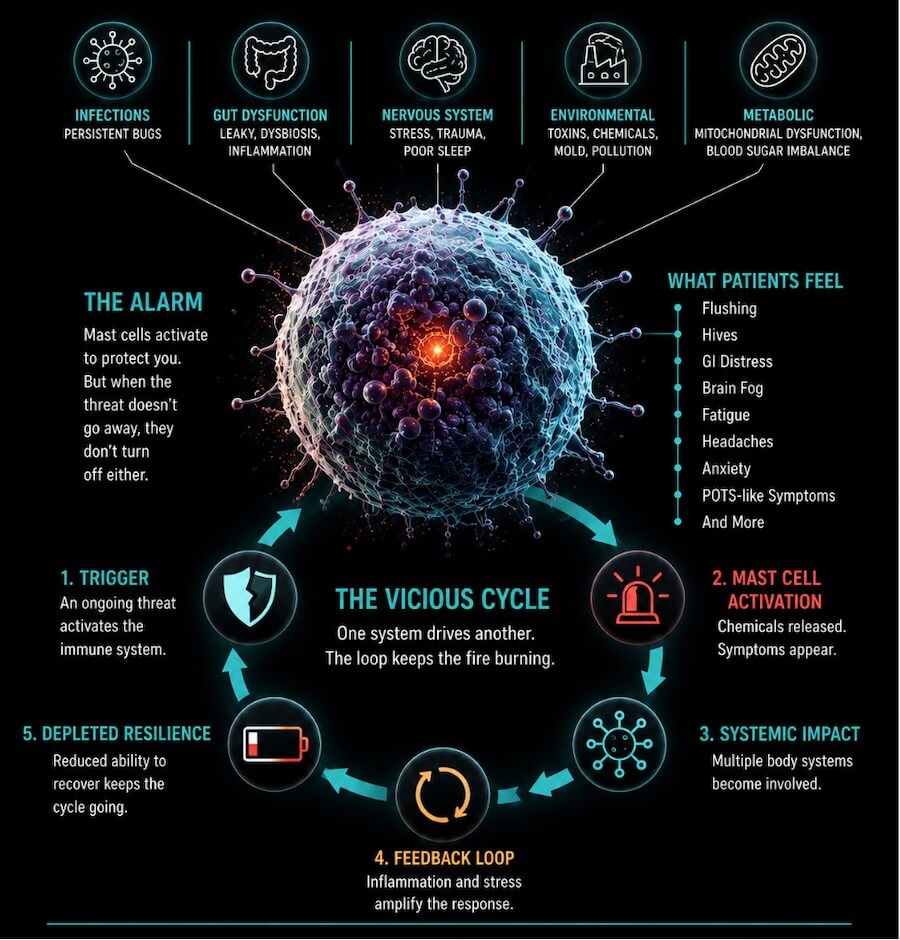
Most chronic diseases emerge when genetics, environment, and physiology begin interacting in ways that gradually overwhelm the body’s ability to maintain balance. Rather than one trigger, it’s often the cumulative weight of many.
Mast cell activation may be no different.
Over the past decade—and especially since the COVID-19 pandemic—we’ve watched several major trends converge at the same time.
Post-viral illness has become impossible to ignore. Long COVID brought unprecedented attention to patients experiencing persistent fatigue, dysautonomia, brain fog, exercise intolerance, gastrointestinal dysfunction, and heightened sensitivity to foods, medications, and environmental exposures. While not every patient with long COVID has MCAS, researchers have increasingly explored mast cell activation as one potential contributor in at least a subset of patients.
At the same time, clinicians have become more aware of the close relationship between the immune system, the nervous system, and the gut. Conditions that were once viewed in isolation—POTS, hypermobile Ehlers-Danlos syndrome, chronic urticaria, histamine intolerance, post-infectious syndromes, and certain functional gastrointestinal disorders—are now being studied as overlapping rather than entirely separate clinical entities.
Modern life may also be placing a greater burden on immune regulation than at any point in recent history. Diets higher in ultra-processed foods, disrupted sleep, chronic psychological stress, sedentary lifestyles, environmental pollutants, and changes in the human microbiome have all been associated with immune dysfunction to varying degrees. None has been proven to cause MCAS, but each represents another variable acting on an already complex system.
Then there’s simple awareness.
Today’s clinician is far more likely to recognize mast cell activation than one practicing 15 years ago. Patients are also arriving informed, often after months or years of searching for answers themselves. Increased recognition inevitably changes what gets diagnosed.
No single factor fully explains what we’re seeing.
Together, however, they begin to paint a more convincing picture.
Perhaps we haven’t reached a point where everyone suddenly has MCAS.
Perhaps we’ve reached a point where multiple biological and environmental pressures are pushing susceptible individuals past their threshold at the very same time clinicians have become better equipped to recognize the pattern.
That combination—a changing world and changing awareness—may explain why mast cell activation has moved from a niche topic to one of the most discussed subjects in modern medicine.
“Mast cells may not be the problem. They may be the messenger.”
Stop Chasing the Mast Cell
When a patient presents with flushing, hives, food reactions, itching, brain fog, palpitations, dizziness, or unexplained multisystem symptoms, it’s easy to focus on the mast cell itself.
Stabilize it.
Block its mediators.
Reduce histamine.
Avoid triggers.
For many patients, those strategies are appropriate. They can reduce symptoms, improve quality of life, and create enough stability for the next phase of care. But symptom management and root-cause investigation are not the same thing.
The question every clinician should eventually ask is not:
“How do I stop the mast cell?”
It’s:
“Why does this patient’s immune system believe it’s still under threat?”
Mast cells are not malfunctioning by default. They are performing one of the oldest jobs in human biology: detecting danger and coordinating a rapid response.
Positioned throughout the skin, respiratory tract, gastrointestinal tract, blood vessels, and around nerve endings, mast cells act as one of the body’s first lines of surveillance. They constantly sample their environment, looking for signals that something is wrong—infection, tissue injury, allergens, toxins, or other forms of stress.
When they detect danger, they don’t simply release histamine. They orchestrate a complex inflammatory response, communicating with the immune system, nervous system, and vascular system to protect the host.
The problem arises when those danger signals never seem to disappear.
An unresolved infection. A compromised intestinal barrier. Chronic immune activation. Persistent autonomic dysfunction. Ongoing environmental exposures. Repeated physiologic stress. These and many other factors may continue sending signals that something isn’t right, even if the original trigger is long gone.
From that perspective, mast cells begin to look less like the disease and more like the messenger.
That doesn’t mean the messenger should be ignored. Patients often need meaningful symptom relief while the larger picture is being investigated. But if treatment never moves beyond suppressing the alarm, clinicians risk missing the reason it keeps sounding.
Perhaps the most productive question isn’t, “How do I calm the mast cell?”
Perhaps it’s, “What is this mast cell trying to tell me?”
That single shift in perspective changes the clinical conversation.
Instead of asking how to silence the immune system, we begin asking what continues to convince it that danger is present.
And that’s where the real investigation begins.
“The question isn’t simply what turned the mast cell on—it’s what keeps telling it the danger isn’t over.”
Looking for the Source of the Alarm: The Gut
If mast cells are responding to danger, one of the first places clinicians should look is the body’s largest point of contact with the outside world: the gastrointestinal tract.
Every day, the intestinal lining is asked to perform an extraordinary balancing act. It must allow nutrients to pass through while keeping bacteria, toxins, food antigens, and other potentially harmful substances where they belong—inside the gut lumen and out of the bloodstream.
When that barrier functions well, the immune system remains remarkably tolerant despite constant exposure to foreign material.
When it doesn’t, the conversation changes.
Disruption of the intestinal barrier, alterations in the microbiome, gastrointestinal infections, inflammatory bowel conditions, and other forms of gut dysfunction can all increase the amount of immune signaling occurring just beyond the intestinal wall. That doesn’t automatically cause MCAS, but it does create an environment where mast cells may be called upon more frequently—and remain activated for longer.
The microbiome may also influence this process in more subtle ways. Certain microbial communities produce metabolites, such as short-chain fatty acids, that help support intestinal barrier integrity and immune regulation. Others may increase local inflammation or even produce histamine themselves, adding another layer of complexity to an already dynamic system.
For the clinician, the practical lesson is straightforward.
A patient whose mast cells seem chronically activated may not simply have a mast cell problem. They may have an immune system responding to persistent signals originating in the gut.
That doesn’t mean every patient needs an exhaustive stool analysis or an elimination diet.
It does mean the gastrointestinal tract deserves thoughtful evaluation—not because it’s fashionable, but because it’s one of the most plausible places for chronic immune activation to begin.
When the gut continuously communicates that something is wrong, mast cells may simply be repeating the message.
“Healthy immune systems don’t just know how to respond. They know how to recover.”
Looking for the Source of the Alarm: The Nervous System
If the gut is one place where the immune system encounters the outside world, the nervous system is another place where it constantly evaluates safety.
For decades, medicine largely viewed the nervous system and immune system as separate. Today, that distinction has become increasingly difficult to maintain.
Research has shown that mast cells and nerve fibers exist in remarkably close proximity throughout the body. They don’t simply occupy the same tissues—they communicate. Nerves release signaling molecules that can influence mast cell activity, and mast cells release mediators that can alter nerve function. It’s a two-way conversation.
This may help explain why symptoms often seem to blur the boundaries between specialties.
A patient experiences gastrointestinal symptoms, but also palpitations.
Skin flushing, but also anxiety.
Migraines, dizziness, fatigue, and sensitivity to smells or medications.
Rather than representing unrelated problems, they may reflect different manifestations of the same underlying network responding to persistent stress.
This is particularly relevant in patients with dysautonomia, including many living with POTS, where the autonomic nervous system no longer regulates physiologic responses as efficiently as it should. The result isn’t simply a cardiovascular disorder. It may represent a broader disruption in how the body senses, responds to, and recovers from internal and external stressors.
That doesn’t mean every patient with autonomic dysfunction has MCAS, nor does every patient with MCAS have autonomic dysfunction. But the overlap is substantial enough that many clinicians now evaluate these conditions together rather than in isolation.
From a functional medicine perspective, this changes the clinical conversation.
Instead of viewing the nervous system as separate from immune function, it becomes another place to ask an important question:
What continues to signal that the body is not safe?
Sometimes the answer is ongoing inflammation.
Sometimes it’s persistent pain.
Sometimes it’s disrupted sleep, unresolved infection, chronic physiologic stress, or another source of continual immune activation.
Whatever the trigger, the nervous system may amplify those signals long after the original threat has passed, making it more difficult for the immune system to return to baseline.
For clinicians, the takeaway is not that every patient needs “nervous system regulation.”
It’s that restoring immune resilience may require looking beyond the immune system itself.
If the alarm is being reinforced by the nervous system, treating only the mast cell may never fully address the problem.
Looking for the Source of the Alarm: The Mitochondria Question
By this point, another question begins to emerge.
What if persistent mast cell activation isn’t driven solely by ongoing danger signals?
What if part of the problem is the body’s reduced ability to restore balance once those signals appear?
This is where mitochondria enter the conversation.
Traditionally described as the cell’s “powerhouses,” mitochondria do far more than produce ATP. They play a central role in cellular signaling, oxidative stress, tissue repair, and immune regulation. Increasingly, researchers recognize that immune cells depend on healthy mitochondrial function not only to respond appropriately—but also to resolve inflammation when the threat has passed.
This raises an intriguing possibility.
If mitochondrial function is compromised—whether by chronic illness, persistent inflammation, infection, environmental stressors, or other factors—the immune system may become less efficient at returning to homeostasis. The alarm is triggered appropriately, but the “all clear” signal may be delayed.
While this hypothesis continues to evolve, it aligns with a broader principle seen throughout physiology: recovery requires energy.
Repair requires energy.
Resolution requires energy.
For clinicians, the implication isn’t that every patient with suspected MCAS has mitochondrial dysfunction. It’s that persistent immune activation may be worth viewing through a wider lens.
The question may not only be, “What turned the mast cells on?”
It may also be, “What is preventing the body from turning them off?”
A Different Way to Approach the MCAS Patient
If this article has one practical takeaway, it’s this:
Don’t let the diagnosis become the destination.
Whether a patient ultimately meets formal criteria for MCAS matters. But from a functional medicine perspective, the diagnosis is often the beginning of the investigation—not the end.
Instead of asking, “How do I treat MCAS?” consider asking four different questions.
1. What is keeping the immune system activated?
Look for the ongoing signals that may be telling the body something is still wrong.
That could include a persistent infection, gastrointestinal dysfunction, chronic inflammation, environmental exposures, or another source of continual immune activation. Not every patient will have an obvious answer—but every patient deserves the question.
2. What is preventing recovery?
A healthy immune system doesn’t just respond to danger. It knows when to stop responding.
Ask what may be limiting the patient’s ability to return to homeostasis. Poor sleep, inadequate nutrition, metabolic dysfunction, impaired recovery, and other physiologic stressors can all reduce resilience, even if they aren’t the original trigger.
3. Which systems are involved?
Resist the temptation to view MCAS as an isolated immune disorder.
Consider how the gut, nervous system, endocrine system, metabolism, and immune system may be influencing one another. Patients with complex chronic illness rarely fit neatly within a single specialty or organ system.
4. Where can I create momentum?
You don’t have to solve every problem at once.
The goal is to identify the highest-impact opportunities to reduce the body’s overall burden and improve its capacity to regulate itself. Sometimes that begins in the gut. Sometimes it’s improving sleep, restoring autonomic function, addressing an ongoing infection, or reducing inflammatory load.
Progress often comes from improving the terrain, not from finding one perfect intervention.
Ultimately, functional medicine isn’t about finding a single root cause.
It’s about recognizing patterns, understanding systems, and identifying the factors that are preventing the body from doing what it was designed to do: adapt, recover, and restore balance.
When you begin asking those questions, the patient in front of you becomes more than a diagnosis.
They become a system with a story waiting to be understood.
The Questions Worth Watching
Despite the rapid growth in research and clinical interest, mast cell activation remains one of the most rapidly evolving areas of medicine.
Many of the questions practitioners are asking today are the very same questions researchers are actively working to answer.
Among the most important:
- Why do some individuals develop persistent mast cell activation while others recover after similar infections or environmental exposures?
- How does post-viral illness contribute to long-term immune dysregulation?
- What role does the gut microbiome play in maintaining—or resolving—mast cell activation?
- How do the nervous and immune systems interact to influence chronic symptoms?
- Could mitochondrial health influence the body’s ability to resolve inflammation?
- Which biomarkers will ultimately prove most useful in identifying clinically meaningful mast cell activation?
- Why do conditions such as POTS, hypermobile Ehlers-Danlos syndrome, long COVID, histamine intolerance, and MCAS appear to overlap so frequently?
These questions don’t represent weaknesses in the science.
They represent the frontier of the science.
As our understanding of immunology, neurobiology, metabolism, and systems medicine continues to evolve, today’s unanswered questions may become tomorrow’s standard of care.
For clinicians, the opportunity isn’t to have every answer today.
It’s to stay curious enough to recognize them when they arrive.
Clinical Considerations
Five reminders to keep in mind when evaluating patients with suspected mast cell activation:
- Treat the diagnosis—but investigate the biology. A label may explain the symptoms, but it rarely explains why they developed.
- Mast cells are often responding, not initiating. Ask what ongoing signals may be keeping the immune system on high alert.
- Think in systems, not silos. The gut, nervous system, immune system, metabolism, and environment rarely operate independently.
- Look for converging drivers. Complex chronic illness is usually the result of multiple interacting factors rather than a single root cause.
- Measure progress by resilience, not perfection. The goal isn’t to eliminate every trigger. It’s to help the body regain its ability to adapt, recover, and regulate itself.
“The goal isn’t to silence the alarm. It’s to understand why it’s still ringing.”
Resources Worth Knowing
For clinicians interested in exploring this topic further, these organizations and publications have helped shape current thinking around mast cell disorders and immune dysregulation:
- Consensus papers on mast cell activation and diagnostic criteria authored by leaders including Lawrence B. Afrin, Mariana C. Castells, and Peter Valent.
- The Mast Cell Disease Society for clinician and patient educational resources.
- Current reviews on neuroimmunology, mast cell biology, and post-viral immune dysfunction published in peer-reviewed journals.
- Emerging research examining the relationship between long COVID, autonomic dysfunction, and mast cell activation.
No single paper—or single expert—has all the answers. Reading broadly and critically remains the best way to stay current in a rapidly evolving field.
Five Questions to Take Back to Your Practice
As you return to clinic, consider these questions when evaluating patients with complex, multisystem symptoms:
- Am I treating the mast cell—or investigating why it’s activated?
- What ongoing danger signals might this patient’s immune system still be responding to?
- Which body systems have I not yet evaluated that could be contributing to the pattern I’m seeing?
- Am I searching for one root cause when multiple interacting drivers may be more likely?
- What is the next highest-impact step I can take to help restore this patient’s resilience?
Dr. Z’s Take
MCAS brought me to my knees.
I’ve spent the last 13 years practicing functional medicine. I’ve cared for thousands of complex patients. Then one day, I became one.
What surprised me wasn’t just how severe it was. It was how difficult it was to navigate.
I know how to read the research. I know who to call. I’ve been fortunate enough to travel outside the U.S. for treatments I couldn’t access here, and I’ve worked hard enough to be able to pay out of pocket for care that many people simply can’t afford.
Even with all of those advantages, there were times I wasn’t sure what the next step should be.
I honestly don’t know where I’d be today without having access to that level of care. And that thought stays with me, because most patients don’t have those options.
Then I think about where we are today.
If post-viral illness is contributing to more immune dysregulation—and I believe we’re seeing that in clinical practice—this isn’t going to be a small problem. Viruses aren’t going away. More practitioners are going to be caring for patients with complex, multisystem illness who don’t fit neatly into a textbook.
That’s why I don’t think the answer is another protocol.
I think it’s a better roadmap.
Where do you begin? What do you stabilize first? When do you lean on conventional medicine, and when do you dig deeper into functional medicine? How do you help patients make progress without sending them down a path that costs a fortune?
Those are the questions I believe we should be answering.
If this article helps even a few practitioners build a more logical path for these patients, then it was worth writing.
MCAS patients need your help.
“Complex illness rarely has one root cause. More often, it’s the convergence of multiple systems that have lost their ability to regulate.”
FAQ
Three explanations are in play. MCAS may have always been common but rarely recognised, scattered across specialties under other labels. Awareness may have grown faster than the disease itself. Or immune dysregulation may genuinely be rising in susceptible people. The evidence does not yet support a single, simple explanation.
Possibly, but it is not settled. Clinicians report growing numbers of patients with overlapping food sensitivities, environmental intolerances, autonomic dysfunction and post-viral illness. Whether that reflects a true rise in mast cell activation, a broader rise in immune dysregulation, or several overlapping conditions remains an active area of research.
Long COVID brought unprecedented attention to persistent fatigue, dysautonomia, brain fog, exercise intolerance and heightened sensitivity to foods, medications and environmental exposures. Not every long COVID patient has MCAS, but researchers have increasingly explored mast cell activation as one potential contributor in at least a subset of patients.
Conditions once viewed in isolation are now studied as overlapping rather than separate. Mast cells and nerve fibres sit in close proximity and communicate in both directions, so autonomic dysfunction and immune reactivity often appear together. The overlap is substantial enough that many clinicians now evaluate these conditions together.
The intestinal lining must admit nutrients while keeping bacteria, toxins and food antigens out of the bloodstream. Barrier disruption, microbiome alterations, gut infections and inflammatory bowel conditions all increase immune signalling beyond the intestinal wall, creating an environment where mast cells are called on more often and stay activated longer.
It is a hypothesis worth watching. Immune cells need healthy mitochondrial function not only to respond but to resolve inflammation once a threat passes. If that function is compromised, the alarm may be triggered appropriately while the all-clear signal is delayed. Recovery, repair and resolution all require energy.
Stabilising mast cells, blocking mediators, reducing histamine and avoiding triggers can reduce symptoms and create enough stability for the next phase of care. But symptom management and root-cause investigation are not the same thing. If treatment never moves past suppressing the alarm, clinicians risk missing the reason it keeps sounding.
Ask four questions instead of one. What is keeping the immune system activated? What is preventing recovery? Which systems are involved? Where can I create momentum? The diagnosis is usually the beginning of the investigation, not the end — so do not let the diagnosis become the destination.
Sources:
Afrin LB, et al. “Diagnosis of mast cell activation syndrome: a global ‘consensus-2’.” Diagnosis. 2021;8(2):137–152. https://doi.org/10.1515/dx-2020-0005
Akin C, Gülen T, Castells MC, Oude Elberink H, Valent P. “Diagnosis and Management of Patients With Mast Cell Activation Syndromes: Status 2026.” Journal of Allergy and Clinical Immunology: In Practice. 2026;14(1):19–28. https://pubmed.ncbi.nlm.nih.gov/41285202/
Valent P, Akin C, Arock M, et al. “Definitions, criteria and global classification of mast cell disorders with special reference to mast cell activation syndromes: a consensus proposal.” International Archives of Allergy and Immunology. 2012;157(3):215–225. https://pubmed.ncbi.nlm.nih.gov/22041891/
The Mast Cell Disease Society — Mast Cell Activation Syndromes overview. https://tmsforacure.org/overview/mast-cell-activation-syndromes/
Subscribe
Subscribe for free to get the latest insights in your inbox every week.